



What counts as outdoor bike storage?
Outdoor bike storage is any system that keeps bicycles outside the home while protecting them from rain, frost, and theft. It ranges from a simple cover thrown over a bike against a wall to a fully lockable, insulated shed built for six bikes. The right choice depends on three factors: how many bikes need storing, how much space is available, and how much security the bikes require.
For anyone storing more than one bike, or an e-bike with an expensive battery, a dedicated shed is the only option that manages all three factors at once. Covers and simple racks protect against rain but not theft. Garages solve theft but rarely have the floor space to store bikes without blocking the car.
The four main types of outdoor bike storage
Bike sheds
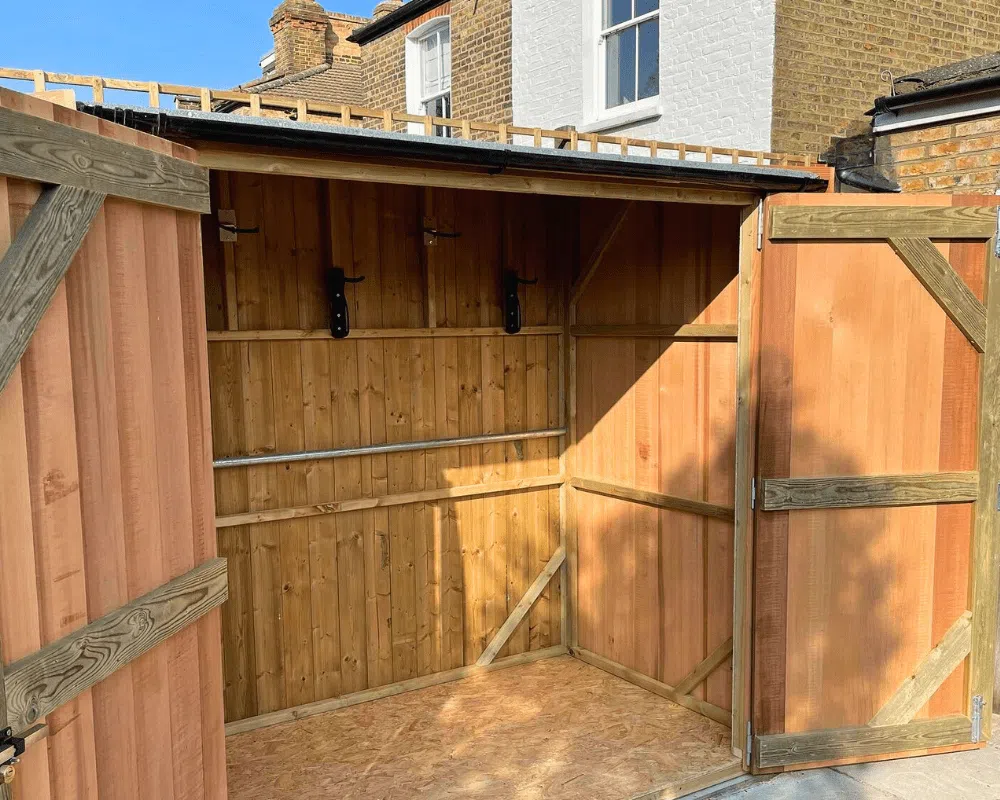
A bike shed is a freestanding, lockable timber or steel structure built specifically for bicycle storage. Unlike a garden shed adapted for bikes, a purpose-built shed has internal locking points, a floor rack or hooks sized to bike dimensions, and a roofline designed around handlebar height rather than general storage.
Bike sheds solve the two problems that other methods cannot: they keep bikes fully dry in a British winter, and they add a second layer of security beyond the bike’s own lock. A shed with a long throw lock and an internal SecureBar means a thief has to defeat two separate barriers, not one.
Wall-mounted racks
Wall-mounted racks hold one or two bikes vertically against an exterior wall, usually under an existing porch, canopy, or eave. They take up almost no floor space and cost a fraction of a shed.
The trade-off is exposure. Unless the wall already has cover, the bike sits in the weather. Wall racks also offer no additional security beyond whatever lock is fitted through the frame, which makes them a poor fit for e-bikes or higher-value bikes.
Bike storage boxes
A bike storage box is a low, lockable container, similar in profile to a large chest, that holds one or two bikes lying flat or leaning at an angle. Boxes work well in tight side passages where a taller shed would not fit under a window sill or fence line.
Capacity is the limiting factor. Most boxes hold no more than two bikes, and the flat or leaning position is not always the most reliable way to store bikes with disc brakes or delicate components.
Garage storage
A garage offers full weatherproofing and, in most cases, decent security, but garages are rarely designed with bike storage in mind. Floor space competes with the car, and floor-standing bikes without a rack tend to fall against each other or block the door.
Garage storage works best for one or two bikes when combined with a simple wall rack or ceiling hoist inside the garage itself. Beyond two bikes, most households find the garage becomes impractical for daily access.
How to choose the right outdoor bike storage for your garden
The decision comes down to bike count, garden depth, and access needs.
For 1 to 3 bikes in a narrow front garden: a shed with a low roofline and a shallow footprint is the priority, since front gardens are typically more space-constrained than back gardens. The Classic Bike Shed is built for this. Bikes are stored front-to-back in a stacked arrangement, and the `width stays fixed at 2000mm regardless of how many bikes you’re storing, so the shed’s footprint grows in depth, not width, as capacity increases. The trade-off is access: reaching a bike at the back means moving the ones in front of it first.
For 2 to 6 bikes with frequent, independent access: a shed where every bike can be removed without touching the others is the better fit. The Slot-In Bike Shed uses a galvanised steel floor rack with bikes stored side-by-side at 400mm centres, so each bike has its own slot and its own clear path out. Depth stays fixed at 2000mm, and width grows with capacity, which means the Slot-In needs a wider garden than the Classic but rewards that space with faster, easier daily use.
For narrow side passages or space-constrained gardens: the Vertical Bike Shed hangs bikes from powder-coated hooks rather than storing them on the ground, which keeps the footprint to a constant 1300mm depth regardless of how many bikes are stored. This is the smallest footprint of the range for a given bike count.
For cargo bikes, tandems, or other long-wheelbase bikes: standard sheds are not built to the extended dimensions these bikes need. The Cargo Bike Shed is available in 2.5m and 3.0m depth variants specifically to accommodate longer frames.
Outdoor bike storage and the weather
Timber bike sheds handle UK weather differently depending on their construction. A shed with a roof overhang that clamps the cladding in place, combined with slatted or tongue-and-groove timber, sheds rain away from the structure rather than letting it pool against joints. Ventilation gaps built into the cladding allow air to circulate around stored bikes, which reduces the moisture buildup that causes chains and cables to corrode over a winter.
Green roof options add a further layer of insulation and rainwater absorption, which some owners choose for the environmental benefit as much as the practical one.
Outdoor bike storage security essentials
Weatherproofing solves half the problem. Security solves the other half, and it matters more for outdoor storage than indoor, simply because a shed at the front or side of a property is more visible and more accessible to an opportunist than a bike kept inside the house.
A well-built bike shed layers three types of protection. Heavy-duty galvanised hinges and drop bolts secure the door itself. A long throw lock, typically supplied with four keys, secures the locking mechanism. An internal SecureBar gives you a fixed anchor point to lock the bike frame to the structure, which matters because a broken shed door is a much smaller loss than a stolen bike.
For anyone wanting a permanent, immovable anchor point, a ground anchor fitted into a concrete base adds a level of security beyond what the shed structure alone provides. This is worth considering for e-bikes or any bike where the insurance value justifies the extra step.
Frequently Asked Questions
A bike shed protects against theft as well as weather, while a cover only protects against weather. A cover left on a bike outdoors advertises its location to anyone walking past and offers no barrier to a thief cutting a single lock.
This depends entirely on the storage method and bike count. A Classic Bike Shed for a single bike needs a depth of 800mm at the base, while the same shed sized for six bikes needs 1350mm. A Slot-In Bike Shed, by contrast, keeps depth fixed at 2000mm and grows in width instead, from 860mm for one bike up to 2600mm for six.
Yes, though not every storage method suits an e-bike's weight and value. The Slot-In and Cargo ranges, which store bikes on the ground rather than hanging them, are better suited to e-bikes than the Vertical range, which is not recommended for heavier bikes.
Most freestanding bike sheds fall under permitted development rules in the UK, meaning planning permission is not required, provided the structure meets height and boundary conditions. Always check with your local council if the shed sits close to a boundary or exceeds typical height limits for outbuildings.
Compare sizes and prices across the full range on our bike sheds overview.