



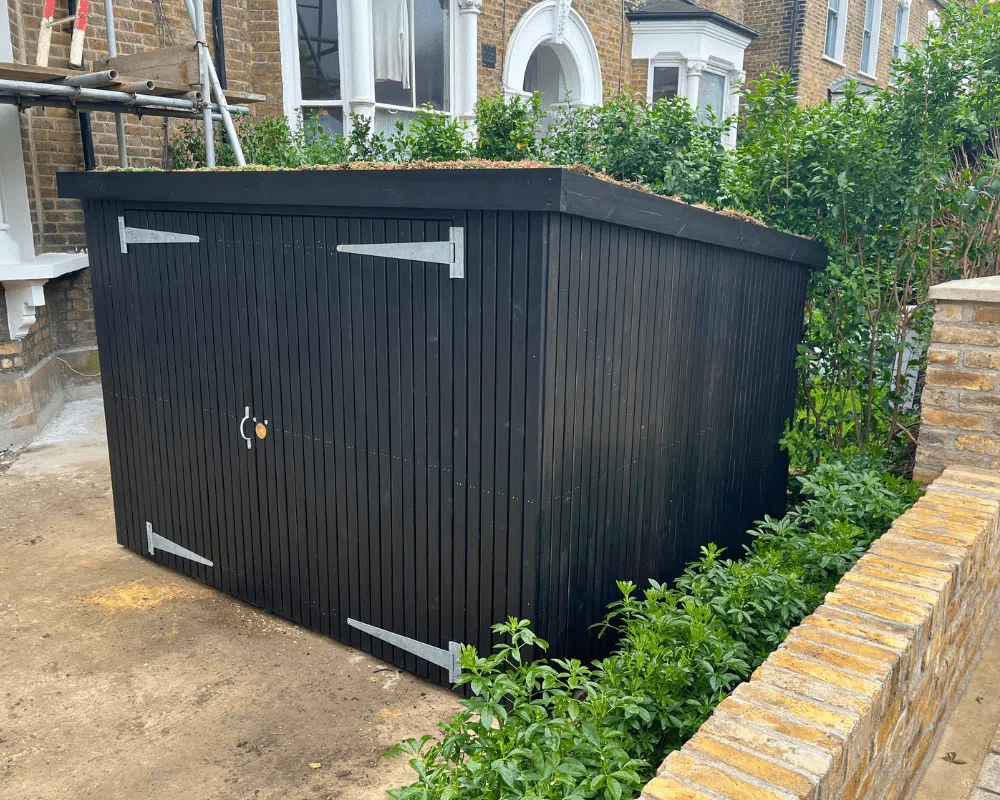
Usually yes, but only if your shed meets the security conditions written into your policy. Most UK content policies cover bikes stolen from a locked outbuilding, subject to a single article limit and evidence of forced entry. Bikes worth more than that limit need to be specified separately, and an unlocked shed defeats most claims outright.
This guide covers what insurers mean by a secure outbuilding, where claims for shed thefts commonly fail, and what to check on your own policy before you need it.
A note on scope: This explains how UK contents insurance generally treats bikes kept in outbuildings. It is not insurance advice, and wording differs between insurers. Read your own policy schedule, and speak to your insurer or a broker before relying on any of it.
Your bike is covered by contents insurance, not bike insurance
“Bike insurance” is shorthand for two different products. When a bike is stolen from your shed at home, the policy that responds is almost always your contents insurance. Specialist cycle insurance is a separate product, designed to cover what contents insurance handles poorly: theft away from home, accidental damage, competitive use, and replacement of high-value frames at full value.
Content insurance treats a bike as one of your possessions, in the same way it treats a laptop or a set of golf clubs. That has two consequences. Your bike competes with everything else in the house for the overall sum insured, and it is subject to every limit and condition the policy applies to possessions. Buildings insurance is a third thing again: it covers the structure of your home, and sometimes permanent outbuildings, but not what is kept inside them.
Some insurers sell contents policies with bike cover built in, or as a named add-on. Where they do, it typically raises the item limit and extends cover beyond your property boundary. Whether you need it depends almost entirely on the next two points.
The single article limit decides whether your claim pays in full
Every content policy sets a single article limit: the most it will pay for any one item unless that item has been declared and listed on the policy. Anything worth more than the limit is only covered to the limit, so a bike above it produces a shortfall at exactly the moment you discover it.
Limits vary widely between insurers, so read the figure on your own schedule rather than assuming a market average. Then compare it against what your bike would cost to replace today, not what you paid. Two categories cross that line routinely. E-bikes carry motor and battery costs that push replacement well past most limits. Cargo bikes do the same on frame and build cost alone.
Declaring the bike is the fix, and it takes one phone call. Insurers refer to this as specifying an item, and it usually adds a modest amount to the premium in exchange for cover at the bike’s actual value. Keep the receipt or a valuation, because the insurer will ask for evidence of what the bike was worth before it will list it.
Insurers treat a shed differently to your house
This is the point most bike owners miss. Many contents policies apply a separate, lower limit to items kept in outbuildings, garages, and sheds than to items kept inside the home. A policy with a generous overall sum insured can still cap everything in your shed at a fraction of it. The bike is covered, but not necessarily for what it is worth, and not necessarily on the same terms.
Some policies go further and exclude specific categories from outbuilding cover altogether. Others extend full cover to a permanent, locked outbuilding but not to a plastic store or an unsecured lean-to, on the reasoning that construction determines how long a theft takes.
Almost all of them then require evidence of forced entry. If a thief opens an unlocked door, or the shed shows no damage, the insurer will usually treat the loss as theft without force and decline. This matters more than any hardware question, and it is worth saying plainly: the most common reason a shed theft claim fails is that the shed was not locked.
The scale of the problem explains the caution. Aviva put the average value of a home theft claim referencing a shed, outbuilding, garage, cabin or workshop at £4,567 in 2025, and a quarter of shed and outbuilding owners it surveyed had experienced a break-in or an attempted one. Separately, the Crime Survey for England and Wales recorded a 21 per cent rise in other household theft in the year to March 2026, to around 791,000 incidents, driven by theft from outside a dwelling. Outbuildings are where the growth is.
The security conditions insurers attach to a bike shed
Insurers set conditions rather than approve products. Read your policy for wording under headings such as security conditions, endorsements or special conditions, because that is where obligations that void cover if unmet are recorded. Five recur.
- The outbuilding must be locked whenever unattended, and kept in good repair. Insurers mean a proper lock, often a BSI-standard one, rather than a padlock through a hasp.
- A theft claim must show visible signs of forced entry.
- You must specify bikes above the single-article limit in advance, not declare them after the loss.
- For higher-value bikes, some insurers require the bike to be locked to an immovable object inside the shed, not just stored there. At least one major UK insurer advises fitting a ground or wall anchor for exactly this reason.
- Where a lock or anchor standard is named, it is usually a Sold Secure rating. Sold Secure is the UK testing scheme insurers reference, and it grades products as Bronze, Silver, Gold or Diamond. It rates locks, chains and ground anchors, and separately certifies cycle storage units under its own specification for those.
That last condition is the one to check before you buy anything. Some insurers require an angle-grinder-resistant anchor, or a Sold Secure Gold rated anchor, as a policy condition for high-value bikes. If yours does, an anchor is not an upgrade; it is the thing your cover depends on.
Our ground anchor fitting service exists for that reason. Fitting is £85 per anchor, you supply the anchor, and it requires a concrete base, so the anchor decision has to be made before the shed is installed rather than after. We fit most models, including the Hiplok AX1000 and the Oxford Beast.
For the wider case on how a shed resists attack, rather than how a policy reads, see our guide to the security features your bike shed needs.
What “insurance approved” means, and what our sheds do and do not carry
Certification schemes for bike storage do exist, and it is worth being clear about them. Sold Secure certifies cycle storage units to its own test specification, separately from the ratings it gives locks. Some mass-produced metal storage units also carry Loss Prevention Certification Board or Secured by Design accreditation, and those are the products sold as insurance approved. Our sheds hold none of those certifications. If your insurer insists on a certified steel unit, buy one.
For most domestic bicycles, though, that is not the test being applied. Insurers set conditions on how the outbuilding locks and on the lock or anchor securing the bike, not on which storage product you bought. A certified unit tends to come up only where the bike is worth enough to warrant a specific security endorsement. So the question that decides your cover is the narrower one: does this shed let you satisfy the five conditions above?
On that test, the Corten Steel Bike Shed is the strongest model Brighton Bike Sheds builds. Corten weathering steel clads all sides over a timber frame, which adds time and difficulty to a cutting attack rather than preventing one, so it is angle-grinder-resistant and not angle-grinder-proof. Every shed we build locks with a hardened steel long-throw bolt supplied with four keys, hangs on galvanised T-hinges fixed with one-way security screws, and carries a 32mm galvanised steel SecureBar drilled into the rear frame, which gives you the immovable internal anchor point a higher-value policy condition asks for. The roof overhangs the doors by 40mm, leaving no purchase for a crowbar. You can add a galvanised steel mesh door lining and a 125-decibel movement-activated alarm as options. The full breakdown sits on our bike shed security page.
The practical value of a shed like this is not a discount and not a badge. It is that it answers each condition in turn. It locks properly, so the locked-outbuilding condition is met. It gives a thief nothing quiet to work with, so a forced entry leaves the evidence a claim needs. It has an internal anchor point, so a bike can be locked to something rather than merely stored. And it takes a ground anchor on a concrete base, so a rated-anchor condition is satisfiable. That is what to tell your insurer, in those terms, and it is worth getting the answer in writing.
Five things to do before you need to claim
- Find your single article limit and your outbuilding limit on your policy schedule. Both figures, not just the headline sum insured.
- Specify any bike worth more than the single article limit, and check whether your insurer counts an e-bike as a bicycle at all. Some classify them separately.
- Photograph each bike, keep the receipt or a written valuation, and record the frame number. An insurer that cannot verify what was stolen has grounds to settle low.
- Register the frame number with BikeRegister, the police-approved national cycle database. It costs nothing at the basic level and gives you a third-party record of ownership.
- Tell your insurer what the shed is, how it locks and whether a ground anchor is fitted, and ask them to confirm in writing that it satisfies their security conditions. A confirmation obtained now is worth considerably more than an argument later.
If your bike is stolen from your shed
Report it to the police first and get a crime reference number. Most insurers will not open a theft claim without one. Then notify your insurer inside the window your policy specifies, which is often short.
Photograph the damage to the shed, the door and the lock before you repair anything. Forced entry is the evidence your claim rests on, and repairing it destroys that evidence. Mark the bike as stolen on BikeRegister, and add the listing to the claim file as proof of ownership.
If the claim is declined and you believe the decision is wrong, ask for the reasons in writing, including the specific policy clause relied on, then complain through the insurer’s own process. The insurer has eight weeks to give a final response. After that, or if you disagree with it, the Financial Ombudsman Service will review the decision free of charge, and you normally have six months from the final response to refer to it. Take that route rather than accepting a decline you disagree with, particularly where the dispute turns on whether your shed met a security condition.