



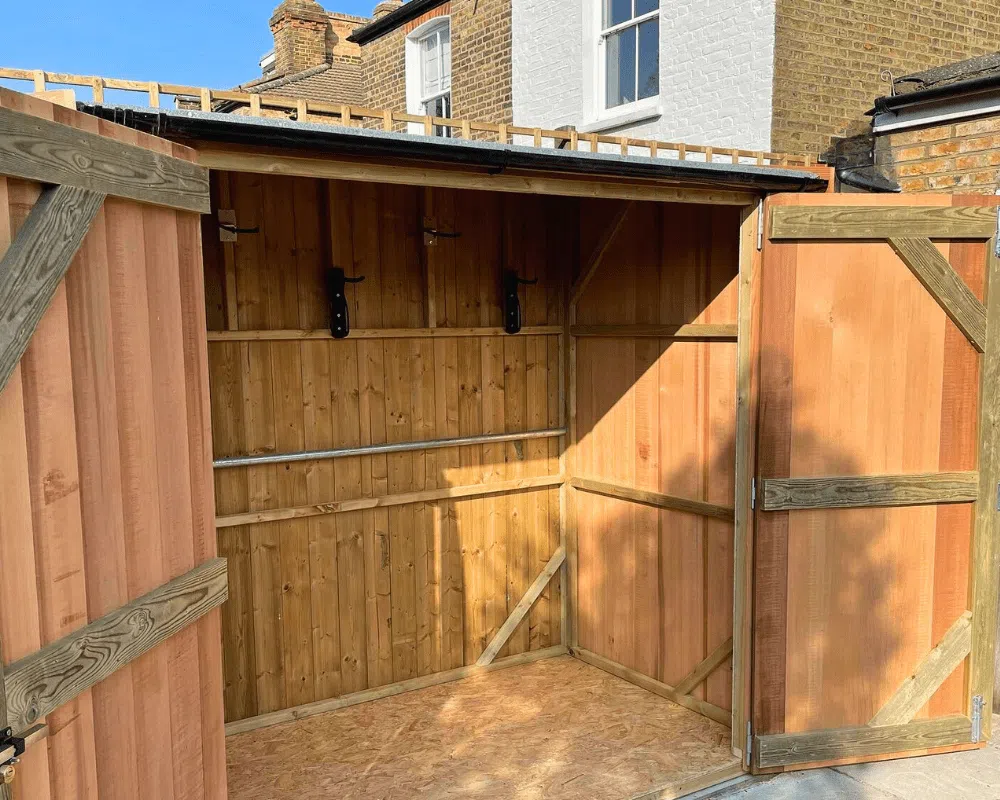
Keep the bike and the battery in two different places. The bike is fine in a locked shed outside. The battery isn’t. Bring it indoors and keep it between 10 and 20 degrees, at a 30 to 60 percent charge, in a room with a smoke alarm and a door you can shut.
Why e-bikes break the usual storage advice
Storing an e-bike is not the same as storing an ordinary bike. Most of the advice you’ll find online was written before e-bikes were common.
The first thing you notice is the weight. An e-bike is roughly twice as heavy as a normal bike. Lifting one onto a wall hook is a two-handed job, and most hooks and racks were never built for it.
The second thing is the size. Family and cargo models are longer than a standard bike, and often longer than the inside of a garden shed. Measure before you buy anything.
The third thing is the battery, and it matters most. A bike battery is not like a torch battery. If it’s damaged or faulty it can catch fire, and that changes where you should keep it.
The fire service has been warning about this for years. London Fire Brigade’s figures for 2025 record 206 e-bike and e-scooter fires in the capital. Of those, 171 involved e-bikes. It’s the worst year they’ve recorded. In 2018 the figure was three.
Two people died in these fires in 2025. That takes the total to five in 2023.
Be careful how you read that data. The Brigade blames battery failure, conversion kits and chargers. Cheap products bought online are the main culprit. Where you store the bike isn’t a cause. What it decides is what happens next.
Bike outside, battery inside
Most guides skip this, so here it’s plainly. The bike and the battery don’t have to live in the same place.
Read the two sets of advice separately and you get stuck. The fire service says keep an e-bike off your escape route. So not the hallway, and not the landing. The manufacturers say don’t leave the battery in an unheated outbuilding.
Put them together and the answer is obvious. The frame, motor, wheels and display cope fine outdoors. The battery doesn’t. So, the bike goes in the shed, and the battery comes in with you.
Pick a room you’d happily shut a door on. Nearly every e-bike battery comes out with a key, so this is a ten-second job on your way past.
If yours is built into the frame, skip to the charging section. Your options are different.
Where not to put it
A few spots come up again and again in fire service warnings. People pick them because they’re convenient.
The hallway is the big one. If the battery fails there, the fire sits between you and the front door. After a ground-floor lobby fire in May 2026, the Brigade made the same point again. Keep the bike somewhere a closed door can hold the fire back while you call 999.
Communal corridors and bin stores are worse. A fire there affects every flat in the building. Many freeholders now ban it outright.
Cars and vans are the quiet ones. An enclosed metal box in July sun passes the battery’s upper limit fast. Nobody notices it happening.
And an unheated shed, if you leave the battery in the bike. The bike is fine out there. The battery isn’t.
What temperature an e-bike battery wants
Between 10 and 20 degrees.
Bosch motors are in a large share of UK e-bikes. Bosch gives a storage range of 0 to 20 degrees in dry air. In damp air where dew forms, that narrows to 10 to 20 degrees. A British shed in winter is damp air.
Component | Manufacturer range | Typical UK shed, December to February |
|---|---|---|
Battery storage, dry air | 0C to 20C | Regularly below 0C overnight |
Battery storage, damp air with dew | 10C to 20C | Dew forms most nights |
Battery charging | 0C to 40C, enforced by the battery | Often too cold to charge at all |
Motor and display, storage | Minus 10C to 40C | Comfortably within range |
Look at the motor row. The drive unit and display are fine in an unheated shed all winter. That’s why leaving the bike outside isn’t the problem people assume. The battery is the only part that can’t take it.
The charging row catches people out most. A Bosch battery only charges between 0 and 40 degrees, and the battery itself enforces this. Below freezing it won’t charge at all. Most people assume it has died.
How much charge to leave in it
Between 30 and 60 percent.
A battery left at 100 percent all winter ages faster than one left at half. Leaving it flat is worse. Run it right down and forget about it, and it can drop below the level where it’ll accept a charge again.
If you ride all year, this looks after itself. If the bike goes away from November to March, set the level before you put it away. Check it once around January.
Keep it away from anything flammable. Put it somewhere with a working smoke alarm. Under the stairs doesn’t count, and neither does the landing.
Can you charge an e-bike in a shed?
You can. It’s harder to do properly than people expect, and it goes against two pieces of official advice.
Temperature is the first problem. Below zero the battery won’t take a charge. An unheated shed is out for much of the winter.
Supervision is the second. The Brigade ChargeSafe advice says never charge while you’re asleep. A shed at the bottom of the garden is unwatched by definition. A fire in an outbuilding beats one in the hallway, but unattended is still unattended.
If your battery is built in and can’t come indoors, a few things help:
- Get the power in properly, installed by a qualified electrician. Not an extension lead through a window.
- Charge in the daytime, while someone is home and awake.
- Fit a smoke or heat alarm in the shed, and link it to the house.
Use the charger the bike came with. Mismatched chargers turn up again and again in the Brigade’s fire investigations.
Can you store an e-bike vertically?
Only if it’s a light one. The limit is 25kg.
Hanging a bike by its front wheel puts all its weight on one hook and one rim. On an ordinary bike that’s nothing. On a heavy e-bike it’s a different question, both for the hook and for you.
Our Vertical Bike Shed hangs bikes from powder-coated hooks. We don’t recommend it for any bike over 25kg. Most lightweight city and folding e-bikes come in under that. Most commuter, mountain and cargo models do not.
Taking the battery out saves a few kilos, which is often enough to bring a borderline bike under the line. Check the weight your manufacturer quotes for your own model. The FAQs below give typical weights by bike type. Our vertical bike storage guide covers the technique.
Anything heavier should sit on its wheels. The tyres and the ground then take the load, as the bike was designed for.
What size shed you need
Measure the bike first. E-bike geometry varies far more than normal bike geometry, and the wheelbase is usually where the surprise is.
Three of our sheds suit e-bikes. They solve different problems.
The Slot-In Bike Shed suits most e-bike owners. Depth is fixed at 2000mm. Width runs from 860mm to 2600mm. Bikes sit side by side on a galvanised steel floor rack at 400mm centres.
Each bike comes out on its own. That matters when the bike you want is 30kg, and so is the one in front of it. Internal depth is 1900mm, so a standard e-bike fits with room to spare.
The Classic Bike Shed is fixed at 2000mm wide. Depth runs from 800mm to 1350mm, and bikes go in front to back. It suits a narrow front garden or a low fence.
The trade-off is worth stating plainly. Getting the back bike out means moving the front one first, and that’s harder work with two e-bikes. If the e-bike is your daily, park it at the front.
The Cargo Bike Shed is the only one that takes a longtail, a front-loader or a box bike. Base depths are 2500mm or 3000mm. Internal depths are 2400mm and 2900mm. Internal widths run from 1310mm to 1880mm.
Door clearance runs 435mm to 615mm, depending on the model. Check that against the widest part of your bike with the box on. A sliding section of roof lets you lower a long bike in from above.
Take three measurements. Overall length with the front wheel straight. Width at the bars or across the box. Height at the saddle or the bars, whichever is taller.
Check those against the internal dimensions on our specifications page, not the base sizes. The base is always bigger than the space inside. If nothing quite fits, our bespoke service builds to whatever you measure.
Security, and what your insurer will want
An e-bike is worth far more than the bike it replaced. That changes the maths for anyone thinking of taking it.
Normal shed security assumes the contents aren’t worth breaking in for. Two e-bikes in a front garden change that.
Brighton Bike Sheds builds to that standard as a matter of course. Every shed gets a long-throw lock with four keys, heavy-duty galvanised hinges on security fixings, galvanised drop bolts and a secure bar.
Three accessories add usefully to it, and we fit all three. A galvanised steel mesh door lining with 25mm holes, which needs an angle grinder to get through. A 125-decibel movement alarm on a key fob. A second long-throw lock, keyed alike to the first.
Anchoring matters most. A bike bolted to the ground can’t be wheeled off, even if someone opens the doors.
We fit ground anchors at £85 each onto a concrete base, and you supply the anchor. It works with the Hiplok AX1000 and the Oxford Beast, both Sold Secure Diamond. Anchor fitting is booked after the shed order and invoiced separately.
If the bikes justify it, look at the Corten Steel Bike Shed. Corten is angle-grinder-resistant. That’s a real thing, and it’s different from angle-grinder-proof. It buys time, and time is what puts someone off a job in a front garden.
On insurance, read your schedule before you need it. Content policies usually cap what they pay for items in an outbuilding. That cap is often nowhere near the value of two e-bikes.
Many insurers want a lock of a set Sold Secure rating. Some want the bike anchored to something immovable, even inside a locked building. Policies vary a lot.
Check yours, and ring your insurer or a broker if the wording is unclear. We build sheds. We’re not insurance advisers.
Damp, and why ventilation beats sealing
An e-bike has electrical connectors that a normal bike doesn’t. They sit where water collects.
Condensation forms when warm damp air meets a cold surface. Put a wet bike in a cold shed and shut the door, and the moisture has nowhere to go.
Over a winter you get surface rust on the drivetrain. On an e-bike you also get corrosion on the battery contacts and the motor connector.
The fix is airflow. Ours are slatted, with a gutter, outlet and downpipe. Air moves through, and rainwater runs away from the timber.
Wipe the bike down before it goes in, and keep the contacts dry. That handles most of it. Our guide to stopping bikes rusting in a shed has the seasonal routine.
Putting an e-bike away for winter
If the bike is going into hibernation rather than staying in use:
- Clean and dry it, including the contacts and the motor connector.
- Take the battery out and bring it indoors, to a room between 10 and 20 degrees with a smoke alarm.
- Set it to 30 to 60 percent, and check it once around the middle.
- Pump the tyres up, so it’s not sitting on soft rubber for months.
- Put the battery back before the first ride, once it’s at room temperature.
That last step applies to winter riding too. A battery from a warm house gives more range than one that sat at 3 degrees overnight. The cold hides the capacity rather than destroying it.
Is your e-bike legal, and why that matters here
It matters more than it sounds. The bikes that fall outside the law are the same ones dominating the fire figures.
In Great Britain, an e-bike counts as an ordinary bicycle if it’s an Electrically Assisted Pedal Cycle, or EAPC. That means a motor of no more than 250W continuous rated power. Assistance must stop at 15.5mph. The pedals must work. The rider must be 14 or over.
Meet that and you need no licence, no registration, no vehicle tax and no motor insurance.
The Government consulted in 2024 on raising the limit to 500W. It also looked at allowing throttles up to 15.5mph. In early 2025 it confirmed that neither would go ahead. So 250W and 15.5mph still stands.
Push a bike past those limits with a conversion kit or a dongle, and it becomes a motor vehicle in law.
Two things follow. Your cycle insurance probably won’t cover it. And conversion kits show up repeatedly in London Fire Brigade fire investigations.
The rules are still moving. The Product Regulation and Metrology Act 2025 got Royal Assent in July 2025. The Government consulted on the secondary legislation between March and June 2026, and the fire service wants it sooner.
Until it arrives, the practical version is simple. Buy a complete bike from a proper retailer. Use the charger it came with. Leave aftermarket batteries alone.
Electric Bike Storage FAQs
What is the best way to store an electric bike?
Where can I store my electric bike?
Can electric bikes be stored outside in the winter?
Is it okay to store an ebike vertically?
Is it safe to store an electric bike in the garage?
How to store ebike batteries safely?
Should e-bikes be stored inside?
What is the best storage bag for an electric bike?
Three measurements to take before you choose a shed
Measure the bike, then pick the shed round it. You need three numbers. Overall length. Width at the widest point. Weight with the battery out.
Those three tell you whether you’re looking at a Slot-In, a Classic or a Cargo. They also tell you whether hanging it vertically is an option.
If your e-bike is over 25kg or longer than two metres, start with the Cargo and Slot-In ranges. If you would like us to check a specific bike against the internal dimensions, send us the measurements and we will tell you what fits.