



Bike storage ideas fall into a small number of genuinely different approaches: front-to-back stacking, side-by-side racking, vertical hanging, and extended cargo storage, each suited to a different garden shape and bike count. The right idea for a household depends on how much space is available, how many bikes need storing, and how often each one is used. This guide works through the options by scenario, so you can match a solution to your own garden rather than choosing on appearance alone.
Bike storage ideas for a small or narrow garden
A small or narrow garden needs a shed with a fixed, compact footprint rather than one that grows in both dimensions as bike count increases. Two designs fit this brief.
A shed that stacks bikes front-to-back keeps its width fixed regardless of how many bikes it holds, which means the footprint grows in depth only. This suits narrow front gardens where width is the constraint, at the cost of needing to move front bikes to reach the ones stored behind them. The Classic Bike Shed is built around exactly this storage method.
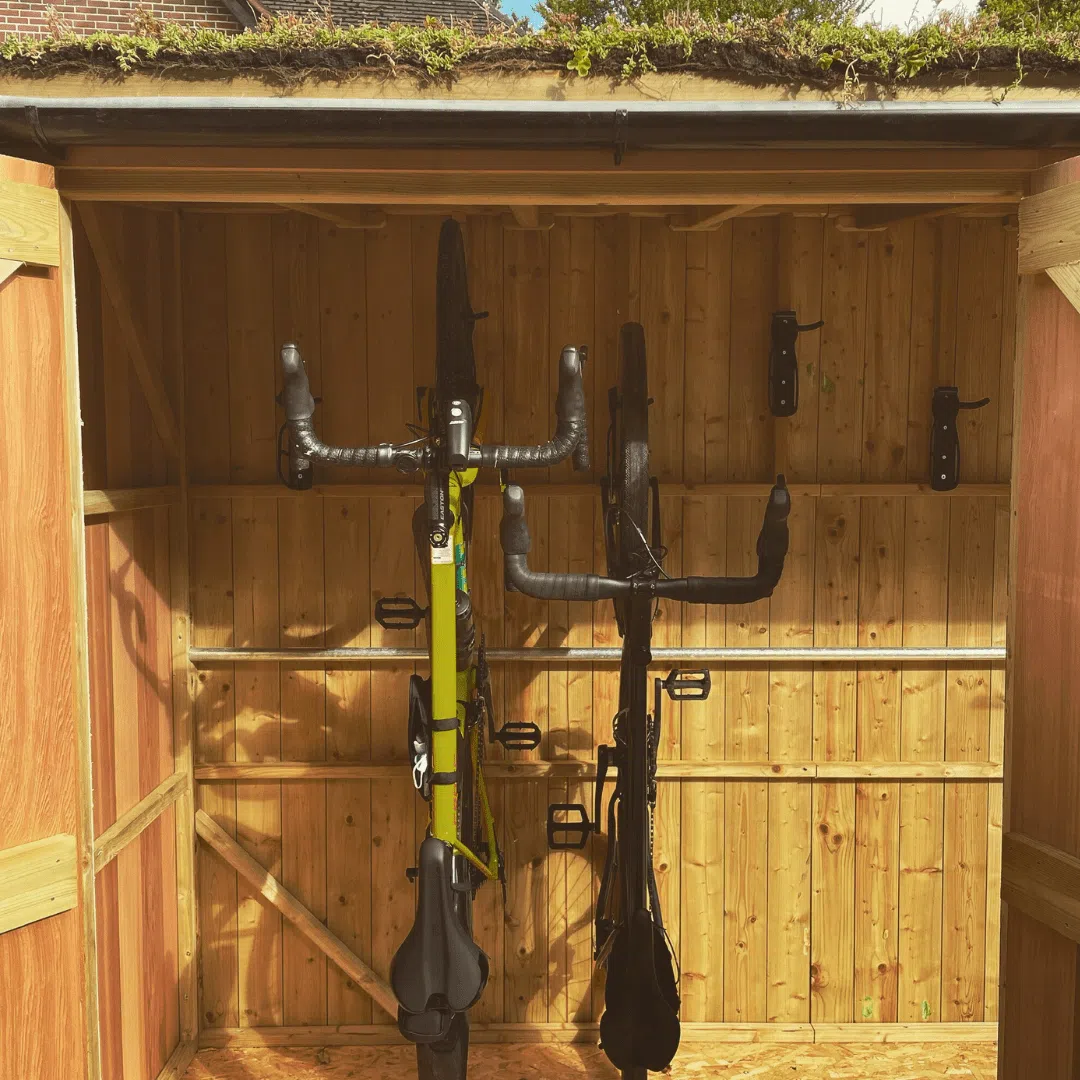
A shed that hangs bikes vertically from wall-mounted hooks keeps its depth fixed at a constant 1300mm regardless of bike count, which gives the smallest possible footprint for a given number of bikes. This suits side passages and space-constrained gardens well, – The Vertical Bike Shed uses this hanging method.
Measuring before choosing matters more here than with any other storage decision. A stacking shed for a single bike needs a base depth of around 800mm, growing to 1350mm for six bikes, while its width stays fixed. A hanging shed for the same range of bike counts needs its width to grow instead, from around 860mm up to 2600mm, while depth stays fixed. Getting these two numbers the wrong way round is the most common measuring mistake, since it is easy to assume every shed grows in the same direction as bike count increases.
Multi-bike storage ideas for daily, independent access
Households with several bikes in regular, independent use need a storage method where each bike comes out without disturbing the others. A shed that stores bikes side-by-side on a floor-level rack solves this directly: every bike sits in its own slot, and removing one has no effect on the rest. The Slot-In Bike Shed is designed specifically for this access pattern.
This method needs more width than a stacking design, since the footprint grows in width as bike count increases while depth stays fixed. It suits back gardens and larger front gardens better than tightly constrained spaces, but it is the strongest choice where a family of two, three, or more people each need their own bike ready to go without a morning shuffle of bikes at the door.
Roll-in access is a genuine practical advantage in wet weather that is easy to overlook when comparing shed types on paper. Wheeling a bike straight onto a floor rack takes seconds and keeps the rider dry, whereas lifting a bike over hooks or manoeuvring it past other stacked bikes takes longer and is considerably less pleasant in the rain. For households where at least one person commutes by bike daily, this difference adds up over a full winter of use.
Cargo bike storage for extended and long-wheelbase frames
Cargo bikes, longtails, and other extended-frame bikes do not fit inside standard shed dimensions, regardless of storage method. Front-loader box bikes typically need 2.4 to 2.8 metres of depth, and longtails need 2.2 to 2.5 metres, both well beyond what a standard bike shed provides.
The only reliable solution is a shed built specifically to that length, available in 2.5m and 3.0m depth options to match different frame sizes. The Cargo Bike Shed within the full Bike Sheds range is built to these extended dimensions.
Secure bike storage ideas for higher-risk areas
In areas with elevated bike theft rates, particularly dense urban boroughs, the shed’s cladding itself needs to resist forced entry, not just the door and lock. A shed clad in weathering steel on all sides adds a layer of impact and prising resistance across the whole structure, which a timber-only shed cannot fully match, though every shed in a well-built range should carry the same internal locking system regardless of cladding material. The Corten Steel Bike Shed is the option built around this approach.
This is worth the upgrade specifically where the shed sits somewhere with less passive surveillance from the house, such as a driveway, side passage, or a street-facing front garden in a higher-theft postcode, rather than as a default choice everywhere.
Combined bike and bin storage ideas for busy gardens
Many gardens need to store more than just bikes: bins, recycling boxes, logs, or general garden equipment all compete for the same space. Rather than building two or three separate structures, a single shed extended with side storage keeps everything under one roofline and one lock.
This works particularly well where a shed’s design already allows an extension along one side wall, since the extra space uses the same roof and cladding as the main structure rather than requiring a second freestanding unit. It is a genuinely space-efficient idea for gardens where every square metre already has a job.
Bike storage ideas for a side passage or narrow access route
A side passage presents a different constraint from front or back gardens: the limiting dimension is usually width, not depth, and the shed needs enough door clearance for a person to actually manoeuvre a bike in and out at the end of the passage.
A hanging shed suits this scenario well precisely because its footprint depth stays fixed regardless of bike count, which matches the fixed width most side passages offer. The door clearance figure matters more here than the headline footprint size, since a passage that is technically wide enough for the shed itself can still be too tight for a bike to turn into the doorway comfortably. Measuring the full turning circle at the access point, not just the passage width, avoids ordering a shed that fits the space but not the bike.
Matching bike storage ideas to your garden: a quick reference
Four core designs cover the range of garden shapes and bike counts described above.
A shed that stacks bikes front-to-back suits narrow gardens with 2.0 metres or more of width, infrequent access needs, and front gardens where a low profile matters. A shed that hangs bikes vertically suits the tightest footprints, side passages, and back gardens, but not e-bikes or heavier models. A shed that racks bikes side-by-side suits households with several bikes in daily, independent use and enough width to accommodate the larger footprint. A shed built to extended depth suits cargo bikes, longtails, and tandems that simply will not fit standard dimensions regardless of storage method.
Every design above is part of the same Bike Sheds range, where you can compare sizes, cladding, and pricing across all four.
Frequently Asked Questions
A shed that hangs bikes vertically from hooks gives the smallest footprint for a given number of bikes, since its depth stays fixed regardless of capacity. It is not suitable for e-bikes or heavier bikes, which need a ground-level storage method instead.
Yes. Several shed designs can be extended with a side storage add-on, which adds a separate lockable compartment for bins, recycling, or garden equipment along one wall, without needing a second structure.
Ground-level storage methods, such as side-by-side racking or cargo-length sheds, suit e-bikes better than hanging storage, since e-bikes are typically heavier and the weight is better supported at floor level than on a wall hook.
Most freestanding bike sheds fall under permitted development rules in the UK and do not need planning permission, provided the structure meets height and boundary conditions. Check with your local council if the shed will sit close to a boundary or exceed typical outbuilding height limits.
Door clearance varies by design and size, typically ranging from around 500mm to 750mm depending on the shed and bike count. Always check the specific clearance figure for the model and size you are considering, since this determines how easily a bike manoeuvres in and out, not just whether the shed fits the available footprint.