



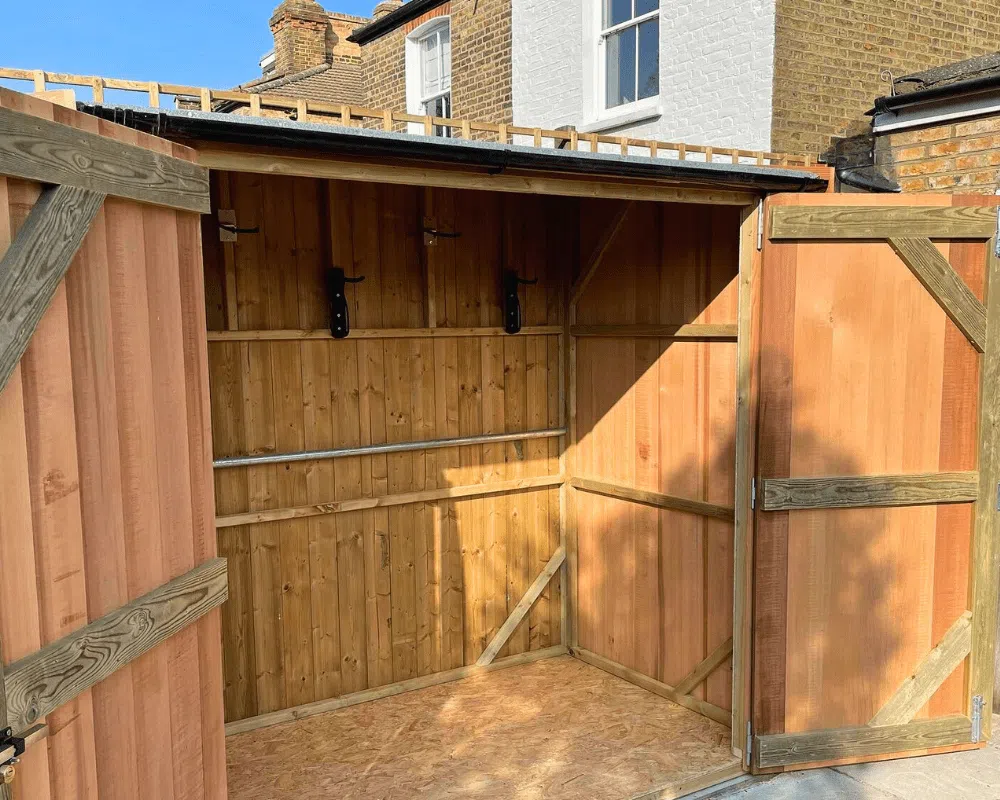
A wooden shed needs about two hours of attention a year, spread across four short passes. Clear the base and gutter in autumn before leaf fall peaks. Inspect the roof after winter storms. Treat pine cladding in a dry summer spell.
This calendar sets out what each season demands, why the autumn pass is the one that matters most in the UK, and which jobs you never need to do.
What Does Seasonal Shed Maintenance Involve?
Seasonal shed maintenance comes down to five recurring tasks. Four of them are inspection and clearing, and take minutes. Only one involves applying anything, and it applies to a single cladding type.
- Clear debris from around the base. The highest-value job on the whole structure, and the only one with your guarantee attached to it. Soil, leaves, ivy, and litter banked against the walls stop the timber from breathing, create a permanently damp zone, and eventually cause rot. A broom or rake, regularly.
- Clear the gutter, outlet and downpipe. Blocked drainage sends water down the cladding instead of away from it.
- Inspect the roof covering. Check felt roofs for wind damage at the edges and laps. Green roofs get their outlet cleared and weeds pulled.
- Oil the moving parts. Lock, hinges and drop bolts. A little oil or grease keeps them working smoothly and stops them seizing.
- Treat pine cladding. Every 2 to 3 years, in a dry spell. Larch and cedar need nothing.
That is the entire list. Anything beyond it is either cosmetic or a repair rather than maintenance.
Why UK Shed Maintenance Follows the Seasons
The UK gets rain in every month of the year, but not in the same quantities and not driven by the same weather. Autumn is the turning point. As the Met Office’s Senior Scientist Mike Kendon has explained, autumn is when UK weather typically becomes more unsettled, with a more active jet stream bringing Atlantic weather systems and associated rain.
The scale of the difference is easy to underestimate. The Met Office recorded UK rainfall of 403.4mm across autumn 2025, more than spring and summer combined at 340.4mm.
That shapes the whole calendar. Every clearing and inspection job on a shed exists to prepare it for wind-driven rain, and the work must be finished before the weather arrives, not after. A gutter cleared in November has already let the first storms overflow. A gutter cleared in September has not.
The seasons also apply three distinct kinds of stress:
- Autumn and winter: water and wind. Sustained rain, saturated ground and gusts that lift roof coverings and load the door openings.
- Winter: freeze-thaw. Water absorbed into a roof covering expands as it freezes and works joints and laps apart. A living green roof shields the membrane beneath it from this cycling.
- Summer: solar UV. Ultraviolet degrades felt and roofing membranes and causes untreated timber to grey. A sedum layer shades the covering underneath it.
Summer is also the only season in which timber is reliably dry enough to take a coating, which is why the one job involving a product sits there and nowhere else.
Spring Shed Maintenance: March to May
Spring is the assessment pass. You are finding out what winter did and putting right anything that moved.
- Clear the winter debris. Leaf litter, silt and windblown material will have banked up against the base since autumn. Rake it back and let the bottom rows of cladding dry out.
- Check for invasive plants. Ivy and climbers reaching the walls hold moisture against the cladding and need to be pulled away from the structure.
- Inspect the roof after the storm season. Check felt edges and laps for lift. Report damage rather than patching it, since our guarantee covers re-felting and repair for felt roofs installed by our team.
- Check the doors and drop bolts. Timber moves seasonally, and spring is when a shed that closed cleanly in autumn starts to bind or sit proud. Both drop bolts should still fall into their sockets under their own weight.
- Oil the lock, hinges and drop bolts. After a wet winter, this is the point at which neglected ironmongery starts to stiffen.
- Weed the green roof. The sedum is entering its growing season. Pull out wind-blown seedlings the same way you would anywhere else in the garden.
Do not treat cladding in spring. The timber is rarely dry enough, and any product applied to damp timber seals moisture in.
Summer Shed Maintenance: June to August
Summer is the only season for applying anything, and for most sheds there is nothing to apply.
The Treatment Window
If your shed is clad in unpainted pressure-treated pine tongue and groove or pine slats, apply Cuprinol Wood Preserver Clear in summer, at intervals of 2 to 3 years. The timber must be dry when the product goes on and remain dry afterwards, which rules out every other season in most of the country. Work with the grain and give extra attention to end grain and cut edges. If you are painting new pine cladding rather than preserving it, leave it to settle for 3 to 6 weeks after installation, then use a flexible exterior paint such as Sadolin Superdec.
No treatment is necessary for sheds clad in Scottish larch or cedar, as both timber types naturally resist rot and decay. While optional, applying oil can be beneficial to restore the wood’s natural oils. Although oiling provides this extra care, many owners choose not to. Allowing the timber to naturally weather to a silver patina is completely fine and remains the most common choice.
Other Summer Jobs
- Establish a new green roof. A newly installed sedum roof needs watering every 2 days for the first 2 to 3 weeks so the roots reach down into the substrate. Rain does the job for you. A shed installed during a dry spell needs a good soaking every other day. After the first month the roof is largely self-sufficient.
- Check the roof covering for UV effects. Summer is when felt shows its age. Look for brittleness and surface cracking, particularly on south-facing slopes.
- Cut back overhanging growth. Do it now, while you can see what is growing where, rather than in October when it is already dropping onto the roof.
- Check the roof overhang is clear. Fences, walls and branches should not be in contact with it. Growth is at its fullest in summer, so this is when contact appears.
Autumn Shed Maintenance: September to November
Autumn is the pass that matters. Everything here is preparation for the wettest, windiest part of the year, and every job is time-sensitive.
- Clear the gutter and outlet before leaf fall peaks. Early autumn, not late. We recommend checking gutters and downpipes yearly for damage and blockages, and autumn is the month to do it. A blocked outlet during the first sustained rain sends water straight down the cladding.
- Clear it again once the trees are bare. One pass is not enough in a garden with deciduous trees nearby. This second clear is the one most people skip.
- Check the downpipe discharge point. Water leaving the downpipe should be carried away from the base. Autumn is when a badly positioned outlet starts doing real damage, because the ground is already saturated.
- Inspect felt edges and laps before the storm season. Fix a lifted edge now and it costs nothing. Leave it and water tracks along the deck all winter.
- Clear debris from the base perimeter. Leaf litter against the walls through a wet winter is how sound cladding becomes soft cladding.
- Clear the green roof outlet. Substrate grit and fallen leaves collect there and stop the roof draining freely.
If you only do one maintenance pass a year, do this one.
Winter Shed Maintenance: December to February
Winter is inspection only. No treatment, no coating, no work that needs the timber to be dry.
- Check the roof after every named storm. Felt lifts at the edges under gusts. A quick look from ground level catches most of it.
- Check for standing water at the base. Saturated ground reveals drainage problems that are invisible in summer. Note where water sits, and deal with the surface in spring.
- Clear snow from the gutter, not the roof. Our roofs are built to be walked on, so snow load is not a concern. A gutter full of frozen slush is, because it stops the roof draining during the thaw.
- Keep the doors working. Cold and damp stiffen ironmongery. If the lock is getting tight, oil it rather than forcing it.
Freeze-thaw is the season’s real mechanism of damage. Water sitting in a lap or a joint expands as it freezes and works the joint open, then more water gets in and the cycle repeats. This is one reason over half the sheds we install carry living green roofs: the sedum and substrate above shield the membrane from freeze-thaw cycling and summer UV alike. Details sit on our living green roofs page.
When Should You Treat a Wooden Shed?
Treat pressure-treated pine cladding every 2 to 3 years, in a dry summer spell, with a clear wood preserver. Do not treat Scottish larch or cedar at any interval. Do not treat the inside of the shed.
The conditions matter more than the calendar date. The timber must be dry to the touch when you apply the product, and it needs a dry period afterwards to cure. A warm, settled week in June or July is worth more than a nominally correct date in April. If the summer is wet, wait rather than applying to damp timber.
For the full product-by-cladding answer, including what happens if you coat larch or cedar and why film-forming sealants fail on moving timber, read our guide to weatherproofing a wooden shed. Cladding options across the range are set out on the cladding options page.
Green Roof and Felt Roof Maintenance Compared
The two roof types need different attention, and neither needs much.
Living green roof | Felt roof | |
|---|---|---|
First month after installation | Water every 2 days for 2 to 3 weeks so roots reach the substrate. Soak every other day if installed in a dry spell. | Nothing. |
Ongoing | Largely maintenance-free after the first month. Pull wind-blown weeds occasionally. | Check regularly for wind damage, focusing on edges and laps. |
After a storm | Clear the outlet if debris has collected. | Inspect for lift at the perimeter and at overlapping joints. |
Winter benefit | Shields the membrane beneath from freeze-thaw cycling. | Directly exposed to freeze-thaw. |
Summer benefit | Shades the membrane from solar UV. | Directly exposed to UV. Check for brittleness. |
If damaged | Contact us. The substrate and liner are a system rather than separate parts. | Our guarantee covers re-felting and repair for felt roofs installed by our team. |
How to Maintain a Bike Shed’s Lock, Hinges and Drop Bolts
Apply a little oil or grease to the moving parts regularly. That is the only maintenance required, and skipping it can turn a smooth door into a forced one.
There are three mechanisms to keep an eye on. The long-throw bolt lock, which comes with four keys. The galvanised T-hinges, fitted with tamper-proof screws. And on double-door models, the 100mm galvanised drop bolts that hold the closed leaf square in its frame.
Two practical points. First, keep at least one of the four keys somewhere other than the shed, which sounds obvious and is the most common thing people get wrong. Second, treat stiffness as a symptom rather than an inconvenience.
Your Shed’s First Year Follows a Different Schedule
A new shed does not slot straight into the annual cycle. Three things behave differently in the first twelve months, and two of the standard jobs are not due at all.
The Green Roof Needs Establishing
This is the only intensive maintenance window a shed ever has. A newly laid sedum roof needs watering every 2 days for the first 2 to 3 weeks so the roots reach down into the substrate below. Rain counts. A shed installed during a dry spell needs a good soaking every other day for that period. After the first month the roof looks after itself, apart from the occasional weed.
The Timber Will Move Through Its First Full Cycle
Untreated larch and cedar also change colour noticeably in the first year, moving toward silver-grey as the surface weathers. That is the timber behaving as specified rather than deteriorating, and no maintenance response is required.
Two Jobs Are Not Due Yet
- Pine cladding treatment. Pine leaves the workshop already pressure-treated, so the first application of clear preserver is due 2 to 3 years after installation, not in the first summer.
- Roof covering replacement. Felt and green roofs are new. First-year roof work is inspection only, and any genuine defect is a warranty matter rather than a maintenance one.
What is due in the first year is the autumn pass. Clear the gutter and the base perimeter before the first wet season the shed has ever seen, because a new shed with a blocked outlet gets wet exactly as fast as an old one.
What the Guarantee Covers, and What Invalidates It
We offer a limited 5 year guarantee on all of our sheds, covering malfunction of the material and manufacturing defects. The same applies to installation faults where the shed was installed by our team.
Two conditions attach to it, and both are directly relevant to maintenance.
- Felt roofs. We cover repair or re-felting under the guarantee only if our installation teams fitted the roof. Inspect, report and let us assess. A self-applied patch can complicate a claim that would otherwise have been simple.
- Debris build-up. If the walls or floor rot prematurely because debris has been allowed to accumulate against them, that invalidates the guarantee. This is the one maintenance task your cover rides on, and it takes a broom.
That second condition is worth reading twice. The cheapest job on the list is also the one that protects everything else.
Your Annual Shed Maintenance Checklist
The full year on one page. Cross-reference against your cladding and roof type.
Task | When | Frequency | Why |
|---|---|---|---|
Clear debris from base perimeter | Autumn and spring | Regularly, at least twice a year | Debris stops timber breathing and holds damp against the cladding |
Clear gutter, outlet and downpipe | Early autumn and again after leaf fall | Yearly minimum, twice where trees overhang | Blocked drainage sends roof water down the cladding |
Check downpipe discharge point | Autumn | Annually | Water must leave the base, not return to it |
Inspect felt edges and laps | Autumn, and after every named storm | As needed | Wind lifts the perimeter first and water tracks along the deck |
Clear green roof outlet | Autumn | Annually | Substrate grit and leaves stop the roof draining |
Weed green roof | Spring | Annually | Wind-blown seed establishes in the substrate |
Water new sedum roof | First month after installation | Every 2 days for 2 to 3 weeks | Roots need to reach down into the substrate |
Oil lock, hinges and drop bolts | Spring | Annually | Prevents seizing and the forcing that follows it |
Treat pine cladding with clear preserver | Dry spell, June to August | Every 2 to 3 years | Maintains the protection applied at manufacture |
Treat larch or cedar cladding | Never required | Not applicable | Both resist decay untreated. Any product is a colour choice |
Cut back overhanging growth | Summer | Annually | Branches on the roof hold water and block the outlet |
Check roof overhang clearance | Summer | Annually | Contact with a fence transfers water onto the cladding |
Inspect after named storms | Winter | As needed | Gusts are what move roof coverings |
How often does a wooden shed need maintenance?
Two short passes a year cover almost everything, in autumn and spring, plus a storm check in winter. Add a treatment session every 2 to 3 years if the cladding is pine. Larch and cedar sheds need no treatment at all.
What is the most important shed maintenance task?
Clearing debris from around the walls and base. Accumulated soil, leaves and ivy stop the timber from breathing, create a permanently damp zone and lead to rot. Premature rot from debris build-up can also invalidate the guarantee, so this takes minutes and protects your cover. You may check our article about shed maintenance tips
Do I need to do anything to a green roof in winter?
Only clear the outlet if debris has collected. The sedum is dormant and needs no attention. It is actively protecting the membrane beneath it from freeze-thaw cycling through the coldest months.
Can I pressure wash a wooden shed?
Avoid it. High pressure drives water into joints and behind cladding, raises the timber grain and can lift fixings. A brush and plain water removes surface dirt and algae without forcing moisture into places it cannot escape from.
Does maintenance affect the guarantee?
Our guarantee covers re-felting and repair for felt roofs installed by our team. Report damage rather than repairing it yourself, since a self-applied patch can complicate an otherwise straightforward claim.
Keeping On Top of It
Put two reminders in your calendar: one in early September and one in March. Those two dates carry most of the year’s work. If your shed is newly installed, our guide to installing a bike shed covers the post-installation checks that come first, and our weatherproofing guide explains what each task is actually protecting.
Anything you are not sure about, send us a photograph, and we will tell you whether it needs action.