



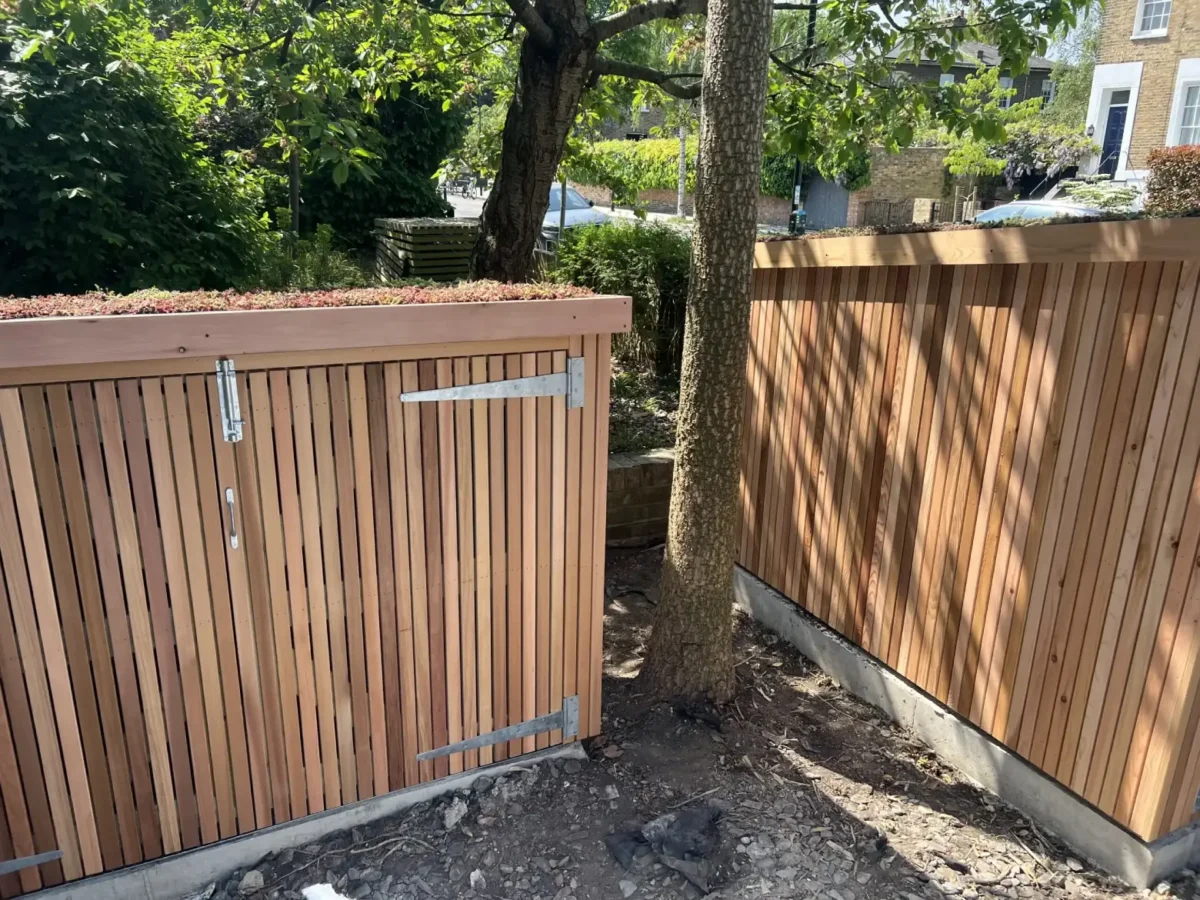
Eco-friendly bike sheds use FSC-certified timber from responsibly managed forests, store carbon rather than emit it, and last 20+ years with proper maintenance. Unlike plastic sheds made from fossil fuels, timber sheds are biodegradable, repairable, and support sustainable forestry. Add a green roof and your shed becomes a habitat for wildlife while insulating the structure.
What Makes a Bike Shed Eco-Friendly?
When choosing bike storage, sustainability extends beyond recycling your old shed. An eco-friendly bike shed considers five critical factors: the source of its materials, its carbon footprint throughout its lifecycle, how long it will last before replacement, what happens when it reaches end of life, and how efficiently it performs during use. Understanding these factors helps you make an informed choice that benefits both your garden and the environment.
1. FSC-Certified Timber (Responsible Forestry)
The Forest Stewardship Council (FSC) certification represents the gold standard in responsible forest management. FSC-certified timber comes from forests managed according to strict environmental, social, and economic standards, verified through independent audits rather than industry self-regulation.
FSC certification guarantees several critical protections. Forests cannot be converted from natural woodland to plantations. Rare, threatened, and endangered species receive habitat protection. Highly hazardous pesticides are prohibited. Forest health and biodiversity are monitored continuously. Environmental impacts are assessed before any forestry operations begin.
The social standards prove equally important. Workers’ rights are protected through fair wages and safe working conditions. Indigenous peoples’ rights are respected. Local communities are consulted on forest management decisions. Training is provided for sustainable forestry practices.
The standard timber industry has caused significant deforestation and habitat loss globally. FSC certification ensures forests are managed for long-term health rather than short-term profit. Chain of custody tracking follows timber from forest to final product, providing transparency throughout the supply chain.
Brighton Bike Sheds maintain full chain of custody documentation for all timber used in their sheds. The company sources FSC-certified Scottish Larch from UK sawmills and FSC-certified Red Cedar from Canadian forestry operations, supporting sustainable forest management in both regions.
2. Do Wooden Bike Sheds Store or Release Carbon?
The carbon footprint difference between timber and plastic sheds proves stark and measurable. Wooden sheds made from FSC-certified timber actively benefit the environment through carbon sequestration, while plastic sheds contribute to carbon emissions from the moment they are manufactured.
Trees absorb carbon dioxide as they grow through photosynthesis. This carbon becomes locked into the wood structure. When timber is harvested and used in construction, that carbon remains stored for the entire lifespan of the structure. In responsibly managed FSC-certified forests, new trees are planted to replace harvested ones, creating a net carbon-positive cycle. At end of life, if the timber biodegrades naturally, the carbon returns to the soil rather than the atmosphere.
The carbon mathematics are compelling. One cubic metre of timber stores approximately 250kg of carbon dioxide. An average bike shed uses between 0.3 and 0.5 cubic metres of timber, meaning each shed stores between 75kg and 125kg of CO₂ throughout its 15-20 year lifespan. This is equivalent to offsetting 500-800 kilometres of car driving.
Plastic sheds present an entirely different environmental profile. They are manufactured from fossil fuels through oil and gas extraction. The manufacturing process requires high energy input, releasing significant carbon dioxide during production. The plastic itself stores no carbon. Instead, it represents carbon that has already been emitted into the atmosphere. At the end of life, plastic sheds are non-biodegradable and typically end up in landfill, where they persist for centuries. Recycling plastic sheds proves difficult due to mixed plastics and UV degradation of the material.
3. Longevity and Durability (Less Waste)
Lifespan directly impacts environmental sustainability. Products that last longer require fewer replacements, reducing manufacturing emissions and waste over time. The durability difference between timber and plastic sheds proves substantial.
FSC-certified timber sheds, when properly maintained, typically last 15-20 years. With excellent maintenance, lifespans of 20-30 years are achievable. Scottish Larch, naturally durable due to high resin content, develops an attractive silver-grey patina as it ages while maintaining structural integrity. Red Cedar contains natural oils that resist rot, offering exceptional longevity without chemical treatment. Tantalith E treatment, a copper-based preservative, protects timber against decay and extends lifespan by 10-15 years beyond untreated wood.
Plastic sheds typically last 5-10 years before UV degradation causes brittling and cracking. Ultraviolet radiation breaks down the polymer chains in plastic, making the material increasingly fragile. Impact resistance deteriorates over time. Most critically, when plastic sheds fail, they cannot be repaired and must be replaced entirely.
The repairability factor separates timber fundamentally from plastic. Individual timber boards can be replaced when damaged. Hardware can be upgraded. Treatments can be reapplied to extend life. The modular nature of timber construction means a 20-year-old shed can be maintained and repaired indefinitely. Plastic sheds offer no such flexibility. When a panel cracks or UV damage weakens the structure, replacement parts are rarely available and entire units must be discarded.
4. Biodegradability (End-of-Life Impact)
What happens to a bike shed at the end of its useful life matters as much as how long it lasts. The environmental impact of disposal represents the final chapter in a product’s lifecycle, and timber versus plastic could not differ more dramatically.
Timber sheds are biodegradable. Wood decomposes naturally through microbial action, returning nutrients to the soil. Untreated timber can be composted or chipped for garden mulch. Even treated timber such as Tantalith E-treated wood can be processed at wood recycling facilities, where it is converted to biomass fuel or recycled timber products. When handled correctly, timber sheds generate zero landfill waste.
Plastic sheds are non-biodegradable. They persist in landfill for 500 years or more without decomposing. While technically recyclable, the reality proves more complex. UV degradation of the plastic during its service life compromises material quality. Mixed plastics used in shed construction make separation difficult. Most plastic sheds end up in landfill, where they slowly break down into microplastics that contaminate soil and groundwater.
The contrast extends to the energy required for end-of-life processing. Timber can be burned as biomass fuel, releasing only the carbon it stored during growth. Plastic recycling requires high energy input and often produces lower-grade material. The circular economy principles that work well for timber prove challenging for plastic outdoor structures.
5. Natural Insulation (Energy Efficiency)
Thermal performance matters for bike storage, particularly when storing e-bikes with temperature-sensitive lithium batteries. The insulation properties of building materials affect internal temperature stability, condensation levels, and long-term durability of stored items.
Timber offers natural insulation properties. Wood has a cellular structure that traps air, providing thermal resistance. This regulates internal temperature, keeping sheds cooler in summer and warmer in winter compared to metal or plastic alternatives. Timber’s breathability reduces condensation, preventing water droplets from forming on walls and stored equipment. For e-bike battery storage, these stable temperature conditions extend battery life and maintain charging efficiency.
Metal and plastic provide poor insulation by comparison. Metal sheds heat up rapidly in summer sun, creating oven-like conditions inside. In winter, metal conducts heat away quickly, causing internal temperatures to match external cold. Plastic offers minimal thermal regulation. Both materials suffer from condensation problems, with water droplets forming on interior surfaces when temperature differentials occur.
The insulation benefit of timber extends beyond immediate comfort. Reduced condensation means less moisture damage to bicycles and equipment. Stable temperatures protect electronic components in e-bike systems. The natural thermal regulation happens passively, requiring no additional energy input or ventilation systems
What Is FSC Certified Timber?
Understanding FSC certification helps you distinguish genuinely sustainable timber from vague “eco-friendly” marketing claims. The Forest Stewardship Council operates as an international non-profit organisation founded in 1993, setting standards for responsible forest management across 80+ countries including the United Kingdom. Unlike industry self-regulation, FSC certification requires independent third-party audits, ensuring compliance with environmental, social, and economic standards.
Three Types of FSC Labels
FSC certification comes in three forms, each indicating different levels of certified content in the final product.
- FSC 100% means all timber originates from FSC-certified forests. This represents the highest standard, guaranteeing complete traceability to responsibly managed sources. While ideal, FSC 100% certification can be challenging for manufacturers to maintain consistently across all products.
- FSC Mix combines timber from FSC-certified forests with controlled sources. Controlled sources are verified as legal and non-controversial, meeting baseline environmental and social standards even if not fully FSC-certified. This pragmatic approach allows manufacturers to scale sustainable practices while maintaining supply chain reliability. Brighton Bike Sheds typically use FSC Mix certification for their Scottish Larch, balancing sustainability with practical availability.
- FSC Recycled indicates material made entirely from reclaimed or recycled wood. While environmentally beneficial, FSC Recycled timber is less common for outdoor structures requiring specific durability characteristics and structural properties.
What FSC Certification Guarantees
FSC environmental standards prevent conversion of natural forests to plantations, protecting biodiversity and ecosystem complexity. Rare, threatened, and endangered species receive habitat protection through designated conservation areas within managed forests. Highly hazardous pesticides are prohibited, preventing chemical contamination of forest ecosystems and water sources. Forest health and biodiversity are monitored continuously, with management plans adjusted based on ecological indicators.
The social dimension of FSC certification protects workers’ rights through requirements for fair wages and safe working conditions. Indigenous peoples’ rights are respected, particularly regarding traditional land use and cultural sites. Local communities are consulted on forest management decisions, ensuring forestry operations benefit rather than harm regional populations. Training for sustainable forestry practices builds local capacity for long-term forest stewardship.
Economic standards require long-term forest management plans that prioritise forest health over short-term profit. Harvesting rates must allow forests to regenerate faster than they are cut, ensuring sustainable yield indefinitely. Chain of custody documentation creates transparency throughout the supply chain, from forest to final product.
How to Verify FSC Certification
Verification protects against false sustainability claims. Look for the FSC logo, which features a distinctive tree checkmark symbol. Every certified product carries an FSC licence code (formatted as FSC-C followed by numbers) that can be verified through the FSC database. The label type (100%, Mix, or Recycled) indicates the certified content level.
Brighton Bike Sheds display their FSC licence code on their website and provide chain of custody certificates on request. The company sources timber from FSC-certified Scottish sawmills and Canadian mills, maintaining documentation throughout the supply chain. This transparency allows customers to verify sustainability claims independently rather than relying on marketing assertions.
Timber vs Plastic: The Honest Comparison
Comparing bike shed materials honestly requires examining multiple factors beyond initial purchase price. Environmental impact, durability, aesthetics, and total cost of ownership all influence the real value of a storage solution.
Environmental Impact
The environmental comparison strongly favours timber across multiple metrics.
- Carbon footprint: FSC-certified timber is carbon negative, storing 75-125kg of CO₂ per shed throughout its lifespan. Trees absorb carbon dioxide as they grow, and this carbon remains locked in the wood structure for decades. Plastic sheds are carbon positive, emitting 150-250kg CO₂ during fossil fuel-based manufacturing. The difference represents 225-375kg CO₂ advantage for timber over a typical shed lifespan.
- Biodegradability: Timber decomposes naturally through microbial action, returning nutrients to soil. Decomposition timescales range from several years for untreated wood to decades for treated timber, but the endpoint is natural reintegration into the ecosystem. Plastic persists in landfill for 500+ years without decomposing, eventually breaking down into microplastics that contaminate soil and water.
- Renewability: Timber comes from trees that regrow. In FSC-certified forests, trees are replanted after harvest, creating a renewable resource cycle. Plastic derives from finite fossil fuel resources (oil and gas) that cannot be renewed on human timescales.
- End-of-life processing: Timber can be composted, chipped for mulch, or processed at wood recycling facilities for biomass fuel or recycled timber products. Most plastic sheds end up in landfill despite being technically recyclable, as UV degradation and mixed plastics make recycling economically unviable.
- Manufacturing energy: Timber processing requires moderate energy for sawing, planing, and treatment. Plastic production requires high energy for polymer manufacturing, moulding, and cooling processes, contributing to higher embodied energy in the final product.
Durability and Lifespan
Longevity proves critical for both economic and environmental value.
- Lifespan: FSC-certified timber sheds last 20+ years with basic maintenance, extending to 20-30 years with excellent care. The natural durability of species like Scottish Larch and Red Cedar, combined with modern treatments, provides decades of reliable service. Plastic sheds typically last 5-10 years before UV degradation causes brittling, cracking, and structural failure.
- Maintenance requirements: Timber benefits from optional annual treatment to maintain original colour and provide additional protection, though many owners choose to let timber weather naturally to an attractive silver-grey patina. Total maintenance time averages approximately 30 minutes per year for treatment application. Plastic requires no maintenance during its service life, but this apparent advantage is offset by the inability to extend lifespan through care.
- Repairability: Individual timber boards can be replaced when damaged, hardware can be upgraded, and treatments can be reapplied to extend life indefinitely. The modular construction allows targeted repairs without replacing the entire structure. Plastic sheds cannot be meaningfully repaired. Cracked panels must be replaced entirely, and replacement parts are often unavailable years after purchase, forcing complete shed replacement.
- UV resistance: Timber remains stable under UV exposure, developing a protective patina that does not compromise structural integrity. Plastic degrades under UV radiation, with polymer chains breaking down to cause brittling, discolouration, and reduced impact resistance over time.
- Impact resistance: Timber flexes under impact without cracking, returning to its original shape. Even when damage occurs, repairs are straightforward. Plastic becomes brittle with age and cracks under impacts that would not damage timber, with cracks often propagating through entire panels.
Aesthetics and Garden Integration
Visual appeal and garden compatibility matter for structures prominently placed in outdoor spaces.
Timber sheds offer a natural appearance that blends harmoniously with garden environments. The organic material complements plants, lawns, and landscaping rather than competing visually. Timber ages gracefully, with species like Scottish Larch developing an attractive silver-grey patina that many owners prefer to newly treated wood. Customisation options include paint, stain, and cladding patterns to match specific aesthetic preferences. The premium appearance suits upmarket properties and formal gardens. Critically, timber sheds can support green roofs, as the structure is designed to bear the 60-120kg per square metre weight of saturated substrate and plants.
Plastic sheds maintain an artificial appearance that clearly identifies the material as plastic. While modern manufacturing has improved plastic shed aesthetics, the synthetic look remains distinct from natural materials. Colour remains relatively stable (though fading can occur), but the initial appearance does not improve with age. Customisation options are limited by the moulded construction method. The budget aesthetic makes plastic sheds less suitable for high-visibility locations or premium properties. Structurally, plastic sheds cannot support green roofs due to weight limitations and attachment difficulties.
The aesthetic comparison favours timber subjectively, but the green roof compatibility represents an objective functional advantage. Green roofs provide environmental benefits, enhance appearance, and extend roof lifespan by 2-3 times compared to standard roofing materials.
Cost Analysis (Total Cost of Ownership)
Purchase price tells only part of the cost story. Total cost of ownership over a typical 15-year period reveals the true economic comparison.
- Initial purchase: Timber sheds cost approximately £800-£2,500 depending on size and specification. Quality timber construction with FSC certification, professional hardware, and features like guttering and security locks justifies the higher initial investment. Plastic sheds cost £300-£800 for comparable sizes, offering clear upfront savings.
- Maintenance costs over 15 years: Timber maintenance costs £100-£300 for optional treatments over 15 years (approximately £7-£20 annually). These treatments extend lifespan and maintain appearance but are not strictly required for structural integrity. Plastic requires £0 maintenance expenditure.
- Replacement frequency: Timber sheds require zero replacements during a 15-year period, with most still functional beyond this timeframe. Plastic sheds typically require 1-2 complete replacements during 15 years as UV degradation and brittling force disposal at 5-10 year intervals. Replacement costs total £600-£1,600 for purchasing new plastic sheds twice.
- Total 15-year cost: Timber sheds total £900-£2,800 (one purchase plus maintenance). Plastic sheds total £900-£2,400 (multiple replacement purchases). The total costs prove remarkably similar, with plastic’s initial cost advantage eroded by replacement requirements.
The cost analysis reveals that timber and plastic converge in total cost despite different price structures. Timber requires higher upfront investment but lower lifetime cost through longevity. Plastic offers cheaper initial purchase but higher lifetime cost through replacement. The quality, sustainability, and aesthetic advantages of timber come at minimal or no premium when calculated over realistic ownership periods.
When Plastic Might Make Sense
Honesty requires acknowledging situations where plastic sheds may be appropriate choices, despite environmental disadvantages.
Choose plastic if you require the absolute lowest upfront cost with no flexibility for higher initial investment. If you have zero time available for any maintenance activities whatsoever, plastic’s no-maintenance characteristic offers genuine convenience. For temporary storage situations where you expect to move within 2-3 years, the shorter plastic lifespan becomes less relevant. If environmental considerations do not factor into your purchasing decision at all, plastic’s sustainability disadvantages become irrelevant to your choice.
However, consider several important factors before selecting plastic. The cheaper initial cost is offset by shorter lifespan and probable replacement costs within 10 years. The lower aesthetic quality makes plastic sheds less suitable for prominent garden locations or high-visibility areas. The significant environmental impact includes fossil fuel consumption, carbon emissions, non-biodegradability, and centuries in landfill at end of life. The inability to support green roofs eliminates upgrade paths that provide environmental benefits, enhanced aesthetics, and extended roof lifespan. Limited customisation options constrain personalisation possibilities.
For most buyers prioritising sustainability, longevity, aesthetics, or total cost of ownership, timber proves the superior choice. For buyers prioritising absolute minimum upfront cost above all other factors, plastic offers that specific advantage while accepting significant trade-offs.
Sustainable Timber Options
Not all timber offers equal sustainability credentials. The species selection, sourcing location, natural durability characteristics, and treatment methods all influence the environmental profile of timber bike sheds.
Scottish Larch (Larix decidua)
Scottish Larch represents an exemplary sustainable timber choice for UK bike sheds, combining local sourcing with natural durability and FSC certification.
- Why it’s sustainable: Scottish Larch is native to the UK, eliminating long-distance transport emissions associated with imported timber. The species grows in Scottish Highlands plantations managed under FSC standards, ensuring responsible forestry practices. As a fast-growing species with 30-40 year rotation cycles, Scottish Larch provides sustainable yield without requiring ancient forest harvesting. UK-grown timber supports Scottish forestry jobs and local economies.
- Natural properties: The timber is naturally durable, classified as Class 3-4 durability due to high resin content that resists decay and insect damage. The dense, strong wood provides excellent structural performance for outdoor applications. Scottish Larch develops an attractive silver-grey patina over time as UV exposure weathers the surface, with many owners preferring this aged appearance to freshly treated golden colour.
- Maintenance requirements: Scottish Larch can be left completely untreated, weathering naturally to silver-grey while maintaining structural integrity. Optional treatment every 2-3 years maintains the golden amber colour of fresh timber and provides additional decay protection. No painting is required at any stage of the shed’s life.
Brighton Bike Sheds use Scottish Larch as the primary timber for most models, sourcing from Scottish sawmills with FSC Mix certification. The choice prioritises local sourcing, natural durability, and support for UK sustainable forestry. The fast-growing nature and Scottish provenance minimise transport emissions while delivering timber performance suitable for 20+ year lifespans.
Red Cedar (Thuja plicata)
Red Cedar represents the premium timber option for bike sheds, offering exceptional durability through natural oil content rather than chemical treatments.
- Why it’s sustainable: Red Cedar comes from FSC-certified Canadian forestry operations employing sustainable management practices. Canadian forests are managed with long rotation cycles of 80-100 years, allowing natural regeneration between harvests. While transport from Canada increases embodied energy compared to Scottish Larch, the exceptional longevity and natural durability offset these emissions through extended lifespan.
- Natural properties: Red Cedar contains natural oils, particularly thujaplicin, that provide exceptional resistance to rot, decay, and insect damage. The aromatic smell proves pleasant and deters insects naturally. The rich reddish-brown colour weathers to silver-grey over years of UV exposure. Red Cedar’s natural oil content eliminates the need for chemical preservative treatments, offering premium performance through inherent wood characteristics.
- Maintenance requirements: Red Cedar can be left entirely untreated, relying on natural oils for protection. Optional UV-protective treatments maintain the reddish-brown colour if preferred, though many owners appreciate the natural weathering progression. As the most durable commonly available timber, Red Cedar offers 25-30 year lifespans even when left untreated.
Brighton Bike Sheds offer Red Cedar as a premium cladding option, sourcing from FSC-certified Canadian mills. While higher cost reflects the premium timber quality and international sourcing, the exceptional durability makes Red Cedar cost-effective over 30-year ownership periods. Customers prioritising absolute maximum lifespan and minimum maintenance select Red Cedar despite higher upfront cost.
Treatment: Tantalith E
Modern timber treatment extends lifespan while maintaining environmental responsibility through safer copper-based formulations.
- What it is: Tantalith E is a copper-based wood preservative applied through pressure treatment processes. The treatment is forced deep into the timber cellular structure under pressure, penetrating beyond surface application to protect the entire board cross-section.
- Why it’s eco-friendly: Tantalith E replaced older arsenic-based treatments (particularly CCA – Chromated Copper Arsenate) that posed environmental and health risks. The copper-based formulation offers lower environmental impact while maintaining effectiveness. Copper occurs naturally in soil, making treated timber safer for garden use than older treatment types. The treatment extends timber life by 10-15 years, reducing the replacement frequency and associated environmental costs of manufacturing and transporting new sheds.
- What it does: The copper content protects against fungal decay by inhibiting the fungi that decompose wood in outdoor conditions. It deters wood-boring insects that can damage untreated timber. Most importantly for bike sheds, it prevents rot in ground contact areas where moisture exposure is highest. Freshly treated timber shows a green tint from copper compounds, which fades to natural wood colour within 6-12 months as the surface weathers.
Tantalith E represents responsible modern timber treatment, balancing longevity benefits against environmental considerations. The pressure treatment provides deeper protection than surface applications, extending usable life significantly compared to untreated timber while avoiding the severe environmental and health concerns of older arsenic-based treatments.
Green Roofs: The Ultimate Eco-Upgrade
Green roofs transform bike sheds from purely functional storage into multi-benefit garden features, providing environmental advantages that extend well beyond basic weather protection.
What is a Green Roof?
A green roof system consists of several integrated layers that support plant growth on the roof structure. The base layer is a waterproof EPDM (Ethylene Propylene Diene Monomer) rubber membrane that prevents water penetration to the timber structure below. Above this sits a drainage layer that allows excess water to flow to gutters while retaining sufficient moisture for plants. A growing medium (substrate) provides a rooting environment for plants, typically 40-80mm deep for extensive green roofs. The top layer consists of sedum plants, specifically low-maintenance succulent species adapted to shallow substrate and minimal care.
The system operates as a self-sustaining ecosystem once established. Sedum plants store water in their leaves, reducing rainwater runoff from the roof. After an initial establishment period of 6-12 months, the green roof requires minimal maintenance beyond annual weeding. The plants thrive on rainfall alone without supplementary irrigation in the UK climate.

Environmental Benefits
Green roofs deliver multiple environmental advantages that compound when combined with FSC-certified timber construction.
- Wildlife habitat: Green roofs attract bees, butterflies, and beneficial insects through flowers and foliage. They provide valuable foraging resources for pollinators, particularly important in urban areas where flower-rich habitat is scarce. The elevated position creates an urban wildlife corridor, connecting green spaces that might otherwise be isolated by built environment. The habitat value proves particularly significant in densely built-up areas like Brighton where garden space is limited.
- Carbon sequestration: Sedum plants absorb carbon dioxide through photosynthesis, adding to the carbon storage already provided by the timber structure. The substrate layer stores additional carbon in organic matter. The combined effect creates net-zero or carbon-negative structures where the shed actively removes CO₂ from the atmosphere throughout its lifespan.
- Rainwater management: Green roofs absorb 50-80% of rainwater falling on the roof surface, significantly reducing runoff to drainage systems. This reduces flood risk during heavy rainfall events and decreases the burden on urban drainage infrastructure. The substrate filters pollutants from rainwater before release. Water release is slowed dramatically compared to hard roof surfaces, reducing peak flow rates.
- Temperature regulation: The substrate and plant layer insulate the shed structure, keeping it cooler in summer and marginally warmer in winter. This extends the temperature regulation benefits already provided by timber construction. At a wider scale, green roofs reduce the urban heat island effect where built surfaces raise local temperatures. The roof membrane is protected from extreme temperature fluctuations and UV exposure, significantly extending its lifespan.
- Air quality improvement: Sedum plants filter air pollutants including particulate matter and nitrogen oxides. They produce oxygen through photosynthesis. Dust particles are captured by plant surfaces and substrate, improving local air quality around the shed.
Aesthetic and Practical Benefits
Beyond environmental advantages, green roofs deliver tangible aesthetic and functional improvements.
- Aesthetics: The living roof creates a natural appearance that blends seamlessly with garden environments rather than standing out as a built structure. The visual interest changes with seasons as different sedum species flower and change colour. The premium appearance adds upmarket character to properties, with green roofs often featured in high-end garden designs. Estate agents report that green roofs can increase property values, particularly in environmentally conscious areas.
- Practical performance: The substrate layer extends roof membrane lifespan by 2-3 times compared to exposed felt roofs. Protection from UV radiation and temperature extremes prevents the degradation that limits traditional felt roof longevity to 10-15 years. EPDM membranes under green roofs can last 50+ years. The substrate and plant layer provide sound insulation, reducing noise from rain and external sources. The damp substrate acts as a fire barrier, making green roofs more fire-resistant than standard felt coverings.
Green Roof Maintenance
One common misconception suggests green roofs require high maintenance. The reality for sedum extensive green roofs proves remarkably low.
- Year 1 (establishment period): Water during extended dry spells until plants establish root systems in the substrate. This typically means watering once per week during summer dry periods for the first season only. Remove weeds monthly as windblown seeds germinate in fresh substrate. Check drainage outlets quarterly to ensure water flows freely.
- Year 2+ (established roof): One annual weeding session of 30-60 minutes removes any unwanted plants that have established. Check drainage outlets annually. No watering is needed once sedum is established, as the drought-tolerant species survive on UK rainfall alone. No fertiliser is required, as sedum thrives in poor conditions and excess nutrients encourage weed growth.
- Lifespan: The green roof system lasts 20-30 years, substantially longer than traditional felt roofs that require replacement every 10-15 years. The EPDM membrane is protected by substrate and plants, preventing the UV and temperature damage that degrades exposed roofing. Sedum plants self-regenerate, with mature plants spreading and young plants growing from dropped seeds.
Sedum Species for UK Green Roofs
Typical sedum mixes include multiple species to provide year-round coverage and seasonal visual variety.
- Sedum acre (Biting Stonecrop) produces bright yellow flowers in May-June. The low-growing spreading habit provides excellent ground coverage. The species tolerates drought and shallow substrate well.
- Sedum album (White Stonecrop) features white flowers in June-July. The evergreen foliage provides winter coverage. This species excels in thin substrate conditions.
- Sedum spurium offers pink or red flowers in July-August. The mat-forming growth habit fills gaps quickly. The species tolerates wetter conditions than most sedums.
- Sedum reflexum (Stone Orpine) produces yellow flowers on upright stems in June-July. The blue-green foliage adds colour variety. The species tolerates exposed windy locations.
These species are specifically chosen for extensive green roof conditions: drought tolerance to survive UK summers without irrigation, low-growing habits keeping height to 10-15cm, shallow root systems suitable for 40-80mm substrate depth, and year-round evergreen coverage maintaining appearance through winter. The flowering period from May through August provides nectar and pollen for pollinators throughout the growing season.
Carbon Footprint of Bike Sheds
Quantifying carbon emissions and storage allows direct comparison of the climate impact of different shed materials. The numbers reveal significant differences in whole-life carbon profiles.
Manufacturing Emissions
The production phase includes raw material processing, manufacturing operations, and transport to point of sale.
- Timber shed (FSC timber): Timber processing requires low to moderate energy for sawing logs into boards and planing surfaces smooth. Treatment processes require moderate energy for pressure treatment vessels and kiln-drying where used. Transport varies significantly: UK-sourced Scottish Larch involves minimal transport emissions, while Canadian Red Cedar includes international shipping. Total manufacturing emissions average 30-50kg CO₂ per shed, varying with transport distance and size.
- Plastic shed: Polymer production consumes high energy for oil refining and chemical processing to create plastic resins. Moulding operations require high energy for heating plastic to moulding temperature, maintaining pressure in moulds, and cooling formed parts. Transport distances are similar to timber for UK-manufactured or imported sheds. Total manufacturing emissions average 150-250kg CO₂ per shed, substantially higher than timber primarily due to fossil fuel feedstock and energy-intensive manufacturing.
The manufacturing phase alone shows timber producing 60-80% less carbon dioxide than plastic for comparable shed sizes.
Carbon Storage
The critical difference between timber and plastic lies in carbon storage during the use phase.
- Timber shed: Growing trees absorb CO₂ from the atmosphere through photosynthesis. This carbon becomes locked into wood structure as cellulose and lignin. When timber is harvested and used in construction, the carbon remains stored throughout the product’s lifespan. A typical bike shed stores 75-125kg CO₂ depending on size and timber volume used (approximately 0.3-0.5 cubic metres). This carbon remains sequestered for 15-20+ years of shed life.
- The net carbon calculation for timber sheds combines manufacturing emissions (+30-50kg CO₂) with carbon storage (-75 to -125kg CO₂), resulting in net carbon negative impact of -45 to -75kg CO₂. The shed has actually removed carbon from the atmosphere when both manufacturing and storage are accounted for.
- Plastic shed: Plastic stores zero carbon during its use phase. The carbon from fossil fuel feedstock has already been emitted during manufacturing. The plastic structure represents carbon that has moved from underground fossil reserves into the atmosphere. Net carbon calculation shows only manufacturing emissions (+150-250kg CO₂) with no offsetting storage, resulting in net carbon positive impact of +150-250kg CO₂.
Timber’s carbon advantage over plastic totals 200-325kg CO₂ per shed, purely from the storage difference.
Whole-Life Carbon Analysis
Calculating total carbon impact across the entire lifecycle includes manufacturing, use phase storage, maintenance, and end of life disposal or recycling.
Timber shed (15-year lifespan):
- Manufacturing: +40kg CO₂ (average for UK-sourced Larch)
- Storage during use: -100kg CO₂ (stored in timber structure)
- Maintenance: +5kg CO₂ (optional timber treatments)
- End of life: 0kg CO₂ (biodegrades naturally or wood recycling)
- Total: -55kg CO₂ (net carbon negative)
Plastic shed (15 years = two sheds needed):
- Manufacturing: +200kg CO₂ × 2 replacements = +400kg CO₂
- Storage: 0kg (no carbon storage)
- Maintenance: 0kg (no maintenance required)
- End of life: 0kg (landfill, no recycling assumed)
- Total: +400kg CO₂ (net carbon positive)
Timber’s lifetime carbon advantage over plastic totals approximately 455kg CO₂ over a 15-year period. This is equivalent to offsetting approximately 3,000km of petrol car driving or the annual carbon footprint of a UK household for one month.
The analysis demonstrates that timber bike sheds actively benefit climate through carbon sequestration, while plastic sheds contribute to climate change through fossil fuel consumption and carbon emissions. When combined with green roofs that provide additional carbon sequestration through living plants, timber sheds with green roofs represent genuinely climate-positive garden infrastructure
Choosing an Eco-Friendly Bike Shed
Selecting sustainable bike storage requires looking beyond marketing claims to verify actual environmental credentials and lifecycle performance.
Sustainability Checklist
Before purchasing any bike shed, ask these critical questions to verify sustainability claims:
- Is the timber FSC-certified? Request the FSC licence code and verify it through the FSC database. Ask for chain of custody documentation showing timber provenance from certified forests to final product. Avoid vague claims of “sustainably sourced” or “eco-friendly” timber without FSC certification, as these marketing terms lack independent verification.
- What species of timber? Local timber like Scottish Larch minimises transport emissions compared to imported species. Naturally durable species require less chemical treatment over their lifespan. Avoid tropical hardwoods even if FSC-certified, as transport emissions from Southeast Asia or South America significantly increase embodied carbon despite responsible forestry.
- What treatment is used? Copper-based treatments like Tantalith E represent safer modern alternatives to older arsenic-based treatments (CCA). Some premium timbers like Red Cedar contain natural oils, eliminating the need for chemical treatment entirely. Avoid products using CCA treatment, which is banned in many countries but may still appear in imported sheds.
- Is a green roof available? Green roofs provide significant environmental benefits including carbon sequestration, wildlife habitat, rainwater management, and extended roof lifespan. Not all sheds can structurally support green roofs – timber frames can be designed for the load, while most plastic and metal sheds cannot bear the weight safely.
- How long will it last? Seek a minimum 15-20 year lifespan for good environmental and economic value. Longer lifespan means less waste, fewer replacement cycles, and lower lifetime carbon impact from manufacturing. Ask about expected lifespan with and without maintenance to understand realistic durability.
- Is it repairable? Check whether individual components can be replaced or if the entire shed must be replaced when any part fails. Timber construction allows board replacement, hardware upgrades, and structural repairs. Plastic sheds rarely offer meaningful repair options, with failed panels forcing complete shed replacement.
- What happens at end of life? Determine whether the shed is biodegradable or recyclable. Timber biodegrades naturally or can be processed at wood recycling facilities. Plastic sheds typically end up in landfill despite being technically recyclable, as degraded plastic and mixed polymers make recycling economically unviable.

Red Flags to Avoid
Certain claims and characteristics indicate products with questionable sustainability credentials.
- “Sustainably sourced” without FSC certification represents a vague marketing claim with no independent verification. There is no standardised definition of “sustainably sourced” timber outside certification systems. The timber could potentially come from illegal logging operations or poorly managed forests. Always insist on FSC certification with verifiable licence codes.
- Tropical hardwoods (Meranti, Teak, Mahogany) carry high transport emissions even when FSC-certified. Shipping timber from Southeast Asian or South American forests to the UK creates substantial embodied carbon. Rainforest habitat concerns persist even with certification, as any harvesting impacts these sensitive ecosystems. UK-grown or European timber represents a better environmental choice for UK consumers.
- Plastic marketed as “eco-friendly recycled” remains fossil fuel-based in origin and non-biodegradable at end of life. The recycled content percentage is often small. “Recycled” plastic sheds are rare and expensive compared to standard plastic options. The fundamental environmental problems of plastic – fossil fuel feedstock, carbon emissions, non-biodegradability, and microplastic pollution – persist regardless of recycled content.
- Metal sheds claiming superior durability have high manufacturing emissions from steel or aluminium production, which requires intensive energy input and generates significant CO₂. They provide poor insulation, creating temperature extremes inside. End-of-life recycling is difficult in practice, as removal of bolts, fixtures, and mixed materials makes clean recycling challenging. The energy required for metal recycling is substantial.
- No maintenance information provided indicates the manufacturer expects poor longevity. Products designed to last provide clear maintenance guidelines to help owners maximise lifespan. Absence of maintenance information suggests the shed will require replacement within a few years, increasing waste and lifetime environmental impact.
Brighton Bike Sheds' Sustainability Credentials
Brighton Bike Sheds integrates sustainability throughout their design, sourcing, and manufacturing processes rather than treating it as an optional marketing feature.
FSC-Certified Timber Commitment
All timber used in Brighton Bike Sheds carries FSC certification, ensuring responsible forestry practices throughout the supply chain. Scottish Larch comes with FSC Mix certification from Scottish sawmills, supporting UK sustainable forestry operations. Red Cedar carries FSC 100% certification from Canadian forestry operations, representing the highest certification standard. Full chain of custody documentation tracks timber from certified forests through processing to final product. FSC licence codes are provided to customers and displayed on the website, allowing independent verification of sustainability claims.
The primary choice of Scottish Larch reflects multiple sustainability priorities. UK-grown timber minimises transport emissions compared to imported alternatives. Sourcing supports Scottish forestry jobs and local economies. The naturally durable timber requires minimal treatment, reducing chemical use. As a fast-growing species with 30-40 year rotation cycles, Scottish Larch provides sustainable timber yield indefinitely when managed under FSC standards.
Green Roof Options
Green roofs are available on all Brighton Bike Shed models – Classic, Vertical, Slot-In, and Cargo – not just premium products. The structural design of timber frames allows weight-bearing for green roofs, unlike plastic or metal alternatives.
The green roof system uses EPDM rubber membrane with 50+ year lifespan when protected by substrate and plants. Pre-grown sedum matting provides an instant green roof appearance from installation day. UK-grown sedum supports local nurseries and ensures climate-appropriate plant selection. Professional installation is included, eliminating DIY complexity and ensuring proper installation for long-term performance.
The environmental benefits compound with FSC timber construction. Carbon sequestration from both timber structure and living plants creates deeply carbon-negative garden infrastructure. Wildlife habitat particularly benefits urban areas like Brighton where garden space is limited. Rainwater management reduces local flood risk. Extended roof life from substrate protection increases the already substantial 15-20 year timber shed lifespan.
Long-Lasting Design
Brighton Bike Sheds are engineered to last 20+ years through quality materials and thoughtful design details. Tantalith E copper-based treatment protects timber against fungal decay and insect damage. Heavy-duty galvanised hardware resists rust and maintains functionality through decades of use. Proper drainage systems including guttering and downpipes prevent water accumulation that could compromise timber. Adjustable rubber feet elevate the structure above ground moisture, preventing the timber base from sitting in standing water.
Quality construction throughout means no shortcuts that might save initial costs but reduce lifespan. Every shed receives inspection before delivery to ensure construction standards are met.
Repairability extends usable life beyond initial design. Individual boards can be replaced if damaged, rather than requiring complete shed replacement. Spare parts remain available years after purchase. Upgrade options allow customers to add green roofs to existing sheds, providing flexibility for customers who initially choose felt roofs but later decide to upgrade.
Local Brighton Manufacturing
Manufacturing in Brighton, UK, reduces transport emissions compared to imported products. Short delivery distances within the UK minimise carbon footprint from transportation to customer locations. Local production supports Brighton jobs and the regional economy. Quality control is maintained through direct oversight, with every shed inspected before leaving the workshop.
Custom sizing is available without standardised waste from fixed dimensions. Customers order sheds sized precisely for their space and bicycle quantity, eliminating the common problem of buying oversized sheds because standard sizes are too small.
The installation service provides professional fitting that reduces errors and ensures proper base preparation. Correct installation extends shed lifespan by preventing common problems like inadequate drainage or unlevel bases that can compromise structure over time. Waste timber from manufacturing and installation is recycled rather than sent to landfill.
Frequently Asked Questions
FSC timber costs 5-15% more than non-certified timber due to certification costs, independent audits, and sustainable forest management practices that may reduce harvest rates. However, this modest premium ensures legal and ethical sourcing while supporting long-term forest health and worker rights. Brighton Bike Sheds include FSC certification as standard rather than charging it as an upcharge, making the sustainable choice the default option.
FSC timber sheds last 15-20 years with basic maintenance (optional annual treatment), extending to 20-30 years with excellent care and natural weathering to silver-grey patina. Plastic sheds typically last 5-10 years before UV degradation causes brittling, cracking, and structural failure requiring complete replacement. Timber's longer lifespan means fewer replacements over a 30-year period (one timber shed vs three plastic sheds), reducing waste and total carbon impact significantly.
Timber sheds benefit from optional annual treatment to maintain golden colour and provide additional protection, requiring approximately 30 minutes per year for treatment application. However, many owners choose to let timber weather naturally to attractive silver-grey patina, requiring zero maintenance while maintaining structural integrity. Plastic sheds require no maintenance during their shorter service life but cannot be repaired when failure occurs, forcing complete replacement at 5-10 years. The inability to extend plastic shed lifespan through any level of care ultimately proves more costly than timber's optional maintenance.
No. Green roofs add 60-120kg per square metre when the substrate is saturated with water. Timber sheds like those from Brighton Bike Sheds are structurally designed to bear this additional weight through proper frame construction and load distribution. Metal and plastic sheds typically cannot support green roofs safely due to insufficient structural strength and difficulty attaching substrate retention systems to metal or plastic surfaces. Always check with the manufacturer before adding green roofs to existing sheds not originally designed for this load.
Scottish Larch is naturally durable (Class 3-4 durability rating) due to high resin content that resists decay and insect damage. With proper Tantalith E treatment, Scottish Larch matches tropical hardwood lifespans of 15-20 years for outdoor applications. While tropical hardwoods may offer marginal durability advantages, these are achieved at significant environmental cost through international shipping and rainforest habitat impacts. Scottish Larch provides equivalent practical lifespan with far lower transport emissions and support for UK forestry.
Timber sheds are fully biodegradable. Untreated timber can be composted in gardens or chipped for mulch, returning nutrients to soil naturally. Treated timber (Tantalith E) should be taken to wood recycling facilities where it is processed for biomass fuel or manufactured into recycled timber products. Zero landfill waste results when handled correctly. The biodegradation timeline ranges from several years for untreated wood to decades for treated timber, but the endpoint is always natural reintegration into the ecosystem rather than centuries of landfill persistence like plastic.
No. Green roofs prove remarkably low-maintenance once established. During the first 6-12 months, water weekly during dry summer periods until sedum establishes root systems. From year two onwards, one annual weeding session of 30-60 minutes removes unwanted plants. No watering is needed after establishment, as drought-tolerant sedum survives on UK rainfall alone. No fertiliser is required – sedum thrives in poor conditions and excess nutrients encourage weed growth. Green roofs require less maintenance than traditional felt roofs, which need complete replacement every 10-15 years compared to green roof lifespans of 20-30 years.
Timber offers superior insulation, which proves important for e-bike battery storage where stable temperatures extend battery life and maintain charging efficiency. Natural aesthetics blend harmoniously with garden environments. Carbon storage makes timber carbon-negative rather than carbon-positive like metal production. Biodegradability ensures timber returns to natural cycles rather than requiring energy-intensive recycling. Repairability allows individual component replacement rather than complete shed replacement.
Metal sheds have high manufacturing emissions from steel or aluminium production. Poor insulation creates temperature extremes inside (oven-like in summer, freezing in winter). Condensation problems result from poor thermal regulation, with water droplets forming on interior surfaces. End-of-life recycling proves difficult in practice despite theoretical recyclability, as removal of fixtures and mixed materials complicates processing.
Conclusion
Choosing an eco-friendly bike shed requires examining FSC certification, understanding whole-life carbon impact, and considering green roof options that extend environmental benefits beyond basic storage. Timber sheds store carbon rather than emit it, last 2-3 times longer than plastic alternatives, and biodegrade naturally at end of life rather than persisting in landfill for centuries.
Brighton Bike Sheds use FSC-certified Scottish Larch and Red Cedar with optional green roofs available on all models. Built to last 20+ years through quality construction and repairable design, these sheds provide sustainable storage that benefits your garden’s wildlife and the wider environment.
Ready to choose a sustainable bike shed? Explore Brighton Bike Sheds’ timber storage solutions or return to the complete guide to choosing a bike shed for sizing and storage guidance specific to your bicycle types and garden space.